
You’ll need 10-16 hours depending on your brisket’s weight and smoker temperature. A 10-pound brisket requires 6-9 hours at 225°F, while a 15-pounder demands 10-12 hours. Don’t just watch the clock—you’re targeting 195-205°F internal temperature, where collagen transforms to gelatin for peak tenderness. Wrap at 160-170°F, account for the temperature stall, and rest for at least an hour before slicing. The exact timing hinges on mastering three distinct phases that separate good brisket from legendary results.
Understanding Smoking Time Guidelines
When you’re planning to smoke a brisket, you’ll want to start with the fundamental guideline: expect roughly 1 to 1.5 hours per pound for a full-packer brisket that’s starting at room temperature. This baseline calculation accounts for both the flat and point cuts combined.
However, your actual cooking conditions and smoking environment dramatically influence the final timing. Thickness, fat content, and cut type create significant variations around that standard estimate. A 10-pound brisket typically requires 10-12 hours, while a 12-14 pound brisket demands 14-16 hours total. Remember that trimming fat and silver skin can impact how quickly your brisket reaches the desired tenderness. If you increase your smoker temperature to 250°F, you can reduce cooking time to approximately 30 to 40 minutes per pound while still achieving tender results. Set your smoker to maintain 225°F heat throughout the entire cooking process for optimal and consistent results. During the cook, your brisket may hit a temperature stall around 150–160°F where the cooking slows considerably due to moisture evaporation. Use internal temperature rather than cook time as your primary indicator of doneness, as this provides the most reliable gauge for achieving proper tenderness. Many pitmasters choose to wrap the brisket after it reaches 165°F to help preserve moisture and push through the stall. After removing the brisket from the smoker, allow at least a one-hour rest to let the juices redistribute for best results.

More Stable Than Bluetooth: Our advanced RF technology ensures a stronger, more reliable connection than Bluetooth. This smoker thermometer provides the freedom to move around without losing connection! Monitor your BBQ from up to 1,000 feet away!

Ultra-Long Wireless Range:Monitor your food from up to 3000 feet away with Sub-1G wireless technology, which has stronger penetration than bluetooth and delivers signals more stably. Perfect for outdoor BBQs, grilling, or large kitchens, giving you freedom to move without missing a temperature change.

BBQ / Grill pit thermometer, safe and environmentally friendly.
Temperature Recommendations for Optimal Results
Now that you’ve mapped out your cook time based on brisket weight and thickness, you’ll need to establish the temperature at which you’re actually smoking.
You’ve got flexibility here. Most Texas BBQ practitioners anchor their approach at 225°F for consistent results, but you can adjust based on your flavor intensity preferences and brisket quality. Lower temperatures (180°F-225°F) develop subtle smokiness and enhanced tenderness through slower fat rendering. Higher temperatures (250°F-275°F) accelerate cooking while promoting smoke ring formation and exterior crust development.
Your brisket’s marbling distribution matters too. Well-marbled cuts thrive at lower temps, while leaner cuts benefit from faster, hotter cooking. Consider a hybrid approach: start at 180°F, then increase to 250°F-275°F during your final phase for ideal crust development without sacrificing tenderness. At 180°F, fat melts as tenderizer, creating that tender, brisket texture comparable to a fatty ribeye steak when cooked properly. To enhance this process, allow the seasoned brisket to rest at room temperature for at least 30 minutes before placing it on the grill. Once your brisket reaches an internal temperature of 160-170°F, you’ll want to wrap the brisket in foil or butcher paper to retain moisture and continue building that flavorful bark. During the cook, you may encounter the stall around 150-160°F, where the internal temperature plateaus due to moisture evaporation. Always use a reliable meat thermometer inserted in the thickest part of the brisket to accurately monitor the internal temperature throughout the smoking process. When setting up your grill, use indirect heat with a water pan to maintain humidity and temperature stability. Proper fire management is essential to prevent hot spots and ensure even cooking throughout your brisket.
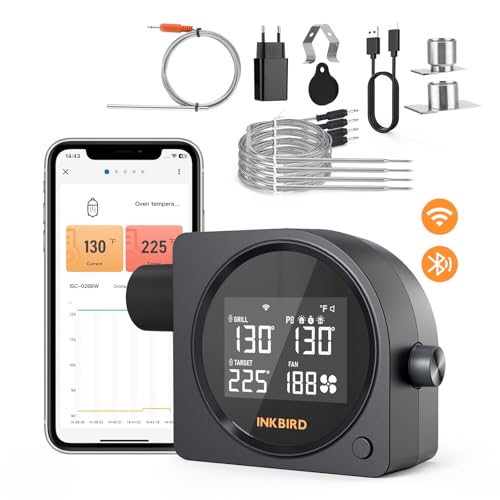
【5G Wi-Fi & Bluetooth5.0 Mode】Inkbird smoker controller fan supports two networking methods;can monitor the grill through smartphone; one smartphone can control multiple smoker controllers at the same time, or multiple people can monitor one smoker controller.

【5G Wi-Fi & 164FT Bluetooth】INKGRILL smoker controller fan supports 5G WIFI and Bluetooth two networking methods;can monitor the grill through smartphone; one smartphone can control multiple smoker controllers at the same time, or multiple people can monitor one smoker controller.

Internal Temperature Targets and Doneness
How’ll you know when your brisket’s truly done? You’ll rely on two critical indicators: temperature and texture.
Target an internal temperature between 195°F and 205°F, with 205°F marking the peak where connective tissue breakdown reaches completion. This range guarantees supple tenderness throughout the meat. Check multiple spots across the flat’s thickest section for consistency.
Beyond the thermometer, perform a probe tenderness test. Insert a thermometer probe into the meat—it should glide through like softened butter with minimal resistance. This tactile feedback confirms that collagen’s transformed to gelatin and tight tissues have fully softened. As the collagen converts, it can absorb up to 10 times its weight in liquid, creating that desirable juicy texture. Using a reliable meat thermometer throughout the process ensures you track these critical temperature milestones accurately. Resting the brisket after cooking allows those redistributed juices to settle throughout the meat for optimal moisture retention. After reaching your target temperature, rest for at least one hour before slicing to ensure maximum juiciness. Like tri-tip, brisket benefits from proper resting time to allow juices to redistribute before slicing.
Don’t rely solely on numbers. Feel determines true doneness. When your probe meets little resistance and your thermometer reads 200-208°F, your brisket’s ready for resting. For optimal results, maintain a smoker temperature between 225°F and 250°F throughout the cooking process. If you need to speed up the process, consider using a water pan to help keep the meat moist and prevent it from drying out.
Brisket Size and Cooking Duration
Your brisket’s weight fundamentally determines how long you’ll need to tend your smoker, though it’s just one piece of the timing puzzle. A 10-pound brisket requires 6-9 hours at 225°F, while a 15-pound cut extends to 10-12 hours, and a 20-pound brisket demands 12-16 hours.
However, thickness matters more than weight alone. Two briskets of different weights but similar dimensions may cook in nearly identical timeframes. You’ll make cooking timeframe adjustments based on shape and dimensional factors that directly impact smoke penetration. Using a wireless leave-in meat thermometer ensures you’re tracking internal temperature accurately rather than relying solely on visual cues. Accurate temperature monitoring with a meat thermometer is critical for achieving perfect doneness, whether you’re smoking brisket or other cuts of meat.
Environmental factors notably influence your actual smoking duration. Outdoor temperature, smoker type, and heat retention capabilities all affect consistency. Pellet smokers with PID temperature control maintain consistency within 5 degrees, which is crucial for low-and-slow brisket cooks that can extend beyond 12 hours. Experienced pitmasters prioritize the toothpick test and tactile assessment over strict weight-based formulas, recognizing that breed, diet, and animal age create meaningful cooking variations. For the highest precision during long smoking sessions, consider a thermometer with ±0.5°F accuracy to eliminate guesswork and ensure consistent results. Most competition-quality briskets are smoked at 250°F to achieve optimal tenderness and smoke ring development. Top-rated models like the Fireboard Pulse excel in ambient temperature accuracy and high-heat tolerance, making them ideal companions for extended smoking sessions. Professional pitmasters also rely on infrared surface thermometers to identify hot and cold zones across the grate, ensuring even heat distribution throughout the cook.

Smart Display Base with Control: The ThermoMaven G1 wireless meat thermometer features a versatile smart display base that offers real-time temperature readings and allows you to set temperatures directly on the device—no app required. With our user-friendly one-click setup, you can connect the probe, pair it with the base, and start cooking in seconds—no complicated setup needed!

SMART BASE CONTROL: Set temperatures, monitor progress, and receive alerts directly from the base without needing your phone nearby.

【Upgraded Higher Durability & 100% Waterproof Probe】1050°F Heat resistant ceramic handles with better sealing design make the meat probe ideal for high-heat cooking like frying, searing and pizza oven, while IPX8-rated waterproof design ensures easy, deep cleaning & long lifespan
The Three Phases of Smoking Brisket
Once you’ve placed your brisket on the grate, you’ll navigate three distinct phases that’ll transform a raw cut into a tender, smoky masterpiece.
Phase 1 kicks off your unwrapped smoking at 225°F–300°F for 3–8 hours. You’ll rotate every 45 minutes, watching bark development emerge and create that prized color and smoke flavor. To enhance moisture and flavor during this initial phase, consider injecting the brisket with a high-quality meat injection before it hits the smoker.
Phase 2 begins around 165°F when you’ll wrap in foil or butcher paper for moisture retention. This 2–8 hour stage accelerates cooking while collagen converts to gelatin, yielding tenderness. Wrapping in aluminum foil creates a seal that traps steam and moisture, similar to how the foil method works for grilling corn. Position a drip pan beneath your brisket to catch rendering fat and prevent flare-ups while maintaining a cleaner smoker.
Phase 3 finishes strong—unwrap for one final hour at your target 203°F–210°F. You’ll firm that bark into a crusty exterior while probe-testing for jiggly tenderness, confirming doneness beyond mere temperature. Using a meat thermometer to monitor internal temperature ensures you hit that perfect target range consistently.
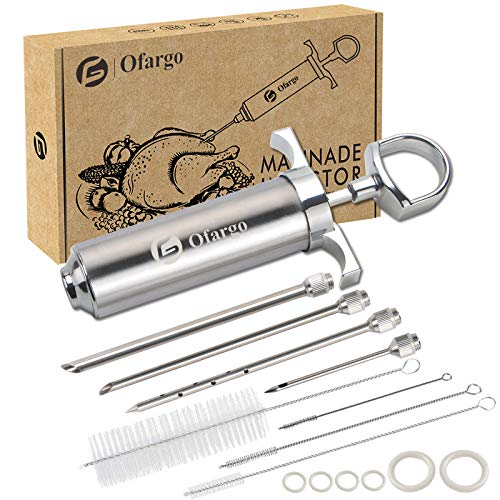
Safe Kitchen/BBQ Tool: stainless steel for meat injector barrel/syringe plunger/meat needles; silicone for O-ring seals; food safe for parts touching marinade/food ingredients, to keep your family safe and healthy

Safe & Healthy BBQ Tool--all components are safe: stainless steel for meat marinade needle and plunger rod; plastic for syringe barrel, handles and pump plate; keep your family safe and healthy

UNBREAKABLE STAINLESS STEEL - Our meat injectors for smoking and grilling are unlike any tool on the market. We’ve built our products with the highest grade 304-stainless steel, corrosion-resistant, and easy to clean. Deliver flavor deep beyond the upper surface; Say goodbye to dry, boring cuts and take your bbq, turkey and brisket injection game to the next level; For people who care about mouthwatering meat, Grillin Pros meat injector syringe kit is the obvious solution.
Using the Texas Crutch Technique
The Texas Crutch—wrapping your partially smoked brisket in foil or butcher paper—fundamentally transforms your cook by trapping steam and collapsing the stall phase that’d otherwise consume 6–10 hours. You’ll wrap when your brisket hits 165–170°F, allowing maximum smoke penetration beforehand. Meat stalls occur when the temperature of the meat stops increasing, often due to evaporative cooling. This wrapping method also significantly decreases overall cook time compared to smoking without intervention.
Your choice between foil vs paper wrapping determines your final texture. Foil creates an impermeable seal, maximizing moisture loss prevention and producing an exceptionally juicy product, though it eliminates bark development entirely. Butcher paper offers compromise—it permits minimal smoke while accelerating cooking and retaining some bark definition. Similar to wrapping ribs in foil during smoking, this technique keeps meat moist while maintaining efficiency throughout the cook. Temperature control and consistency are critical for avoiding overcooking and ensuring the tender results you’re aiming for.
Spray your paper surface with water or oil before wrapping to prevent sticking. Seal tightly along all edges, ensuring no liquid escapes from the bottom or steam from the top. Your brisket’ll finish in 5–8 hours when it reaches 200–205°F internally. Throughout the cook, monitor smoke quality by observing the thin blue smoke from your smokestack, which indicates proper combustion and optimal flavor development. After removing from heat, allow your brisket to rest for 20–30 minutes so the juices redistribute, ensuring a tender and flavorful final product. Using a meat thermometer is the most reliable way to verify doneness rather than relying solely on time estimates.

Designed specifically for the culinary enthusiast, our 18 paper roll dispenser is optimally crafted to handle barbecue butcher paper, thereby ensuring the authentic taste of your smoked meats is maintained. This is your ideal bbq wrapping paper for smoking

【PREMIUM NATURAL QUALITY】Made from premium virgin pulp, our butcher paper is unwaxed, uncoated, and unbleached for a natural and pure product. Ideal for grill masters seeking top-notch, food-safe paper to enhance their culinary creations.
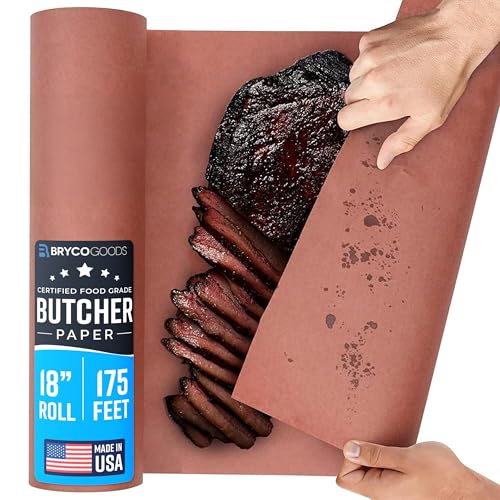
Butchers Paper is ultra durable and strong; does a superior job trapping smoke while releasing steam
Monitoring Progress and Avoiding Common Mistakes
How do you know if your brisket’s progressing correctly without obsessively opening the smoker? You’ll rely on wireless probes and proper thermometer calibration to track internal temperatures accurately. Place one probe in the flat’s thickest section and another in the point, leaving them undisturbed for stable readings. Monitor your smoker’s ambient temperature between 225°F and 250°F using a third probe near the grate. For the most precise temperature measurement, let the probe sit for at least 10 seconds before taking your reading.
Maintain probe hygiene by cleaning between uses to prevent bacterial cross-contamination. Watch for the stall around 165°F to 180°F—it’s normal, not a failure. Rather than fixating on time, probe for tenderness and target 195°F to 203°F internal temperature. A humid environment slows moisture evaporation and helps preserve the surface for better smoke penetration throughout your cook. Your alerts prevent costly mistakes: fuel shortages cause flame-outs while temperature swings derail your cook. Choose thermometers with radio frequency designs over Bluetooth-only models for reliable monitoring from inside your house during long smokes. Just as smoking salmon requires careful temperature monitoring to avoid overheating that causes albumin leakage and dryness, precise brisket temperatures prevent similar texture problems. Once your brisket reaches target temperature, allow it to rest before slicing to redistribute juices throughout the meat. Trust your equipment and resist lid-lifting temptations.
Resting and Serving Your Smoked Brisket
After you’ve pulled your brisket from the smoker at 200°F–205°F internal temperature, you’re not done cooking—you’re entering the critical resting phase that’ll determine whether your meat’s juicy and tender or dry and disappointing.
For ideal resting conditions, use an insulated cooler preheated with hot water. Wrap your brisket in foil, then place it inside to maintain temperatures above 140°F while juices redistribute throughout the meat. This method supports extended resting periods up to 8 hours, allowing collagen to fully gelatinize for superior tenderness. Resting at room temperature should not exceed 1 hour to prevent the meat from entering the danger zone. Some pitmasters drop the brisket to 170–180°F before placing it in a cooler to stop carryover cooking and achieve more precise temperature control.
When you’re ready to serve, vent the wrap initially to release steam before unwrapping completely. Slice against the grain to maximize texture and tenderness. Monitor with a digital probe thermometer to ensure your brisket remains at safe serving temperatures throughout the resting period. For an extra layer of richness, consider adding a pat of butter on top of your sliced brisket before serving, a technique borrowed from reverse sear methods that enhances flavor and moisture. If you’ve used charcoal for smoking, remember to safely extinguish your grill by closing all vents to cut off the oxygen supply rather than dousing with water. Once your cookout is complete, clean the grease tray and exterior surfaces with mild detergent to maintain your grill’s functionality and hygiene for next use. Regularly removing and cleaning burners and drip pans prevents dangerous grease fires and extends your smoker’s lifespan. This methodical approach transforms your smoked brisket into restaurant-quality BBQ that justifies every hour invested.