
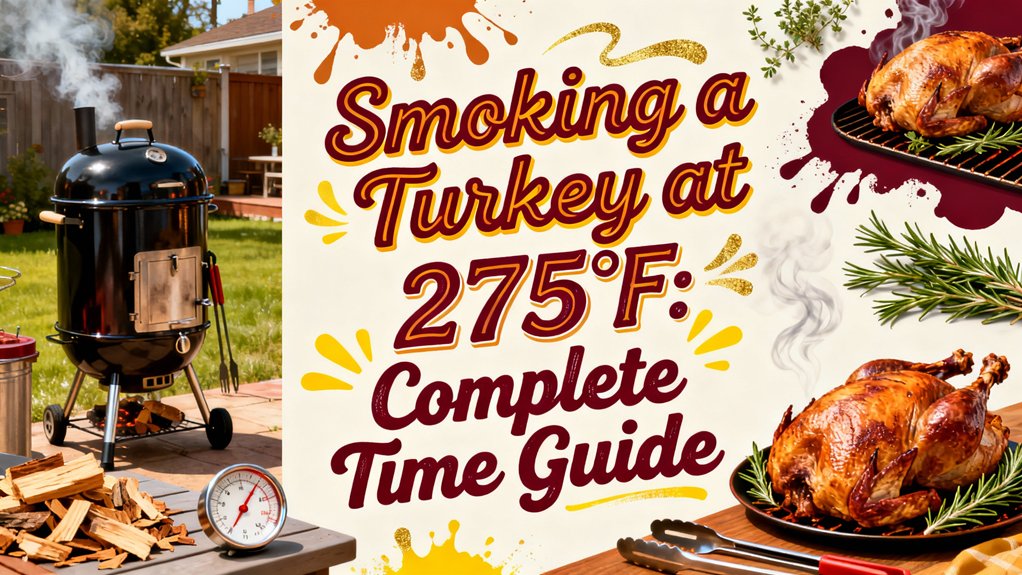
You’ll need roughly 25 minutes per pound when smoking at 275°F, so a 12-pound turkey takes about 5 hours while a 20-pounder requires approximately 8.3 hours. You’ll want to preheat your smoker, position a water-filled drip pan underneath, and monitor the internal temperature until the breast reaches 165°F and thighs hit 175°F. Rotate your bird periodically for even smoke exposure. Following the complete breakdown of temperature management and preparation techniques will guarantee you nail this process.
Cooking Time Guidelines at 275°F
Since you’re smoking at 275°F, you’ll want to plan on 25 minutes per pound as your baseline calculation. This standard guideline helps you estimate total cook time accurately for your specific bird size.
Understanding cooking time variations is essential because turkey sizes dramatically affect your smoking duration. A 12-pound turkey requires approximately 5 hours, while a 20-pound bird needs roughly 8.3 hours. These differences directly impact your holiday meal planning. Using a thermometer to monitor the internal temperature ensures your turkey reaches the proper doneness rather than relying solely on estimated cooking times. At this temperature range, smoking locks in moisture and imparts wood-fired flavor that roasting methods cannot replicate.
However, cooking time limitations exist when maintaining consistent temperature. Temperature fluctuations will extend your cooking period unpredictably, potentially derailing your schedule. Smoker calibration before you begin prevents these timing delays. Many experts recommend brining the turkey beforehand to enhance moisture retention throughout the smoking process. Maintaining a steady smoker temperature between 220–250°F ensures optimal smoky flavor, though 275°F provides a slightly faster alternative. Consider butterflying the turkey to reduce the total cook time to approximately 4 to 4.5 hours while maintaining juiciness and achieving crispy skin. Rotating the bird periodically during smoking ensures even cooking and consistent heat distribution throughout the meat. The internal temperature should reach 165°F in the breast and 175°F in the thigh to ensure food safety.
At 275°F, you’re balancing efficiency with authentic smoke flavor development. This temperature range accelerates results compared to lower settings while preserving the traditional smoking benefits that make your turkey exceptional.

Bluetooth Monitor Remotely: Govee Bluetooth meat thermometer lets you check the temperature of your grill, smoker, or oven from your phone. With this smart BBQ thermometer, you can multitask while grilling.

More Stable Than Bluetooth: Our advanced RF technology ensures a stronger, more reliable connection than Bluetooth. This smoker thermometer provides the freedom to move around without losing connection! Monitor your BBQ from up to 1,000 feet away!

Instant Read Meat Thermometer | Our instant read thermometer features a temperature probe and advanced, highly accurate technology with a 1-2 second response time. Our instant read food thermometer comes pre-calibrated with instructions and a meat temperature chart, plus a recalibration feature if needed.
Understanding Internal Temperature Targets
While you’re monitoring your turkey’s progress in the smoker, hitting the right internal temperatures is what separates a safe, perfectly cooked bird from one that’s either undercooked or dried out. You’ll target 160°F in the breast’s center and 185°F in the dark meat between thigh and drumstick. Your measuring probe placement matters critically—insert it ½ to 1 inch from the internal cavity, parallel to the cutting board. Before you start, calibrate temperature probes using ice water and boiling water tests to confirm accuracy. Use an instant-read thermometer like a Thermapen for spot-checking multiple areas, especially on uneven heat sources. The safest internal temperature for your smoked turkey is 165 degrees F, which ensures harmful pathogens are eliminated throughout the bird. Remember that wireless thermometer monitoring throughout the smoking process helps you achieve the target temperature of 165°F safely and consistently. This multi-point verification guarantees even cooking throughout your bird. Allowing the turkey to rest after smoking helps redistribute juices before carving.
Smoker Temperature Setup and Maintenance
Now that you’ve locked in your target temperatures, you’ll need to dial in your smoker itself—the equipment’s ability to hold steady heat is just as important as knowing what temperature your turkey needs to reach. Start by preheating your smoker to 275°F before placing your turkey inside. Position a water-filled drip pan beneath the bird to regulate temperature stability throughout the cook. Deploy a wireless probe thermometer with an air probe to monitor pit temperature independently of outdoor conditions. Monitoring temperature throughout the cook with a wireless probe is crucial for achieving perfectly cooked turkey breast. A water pan can help stabilize internal smoker temperature while you maintain your cooking process. Monitor fuel replenishment carefully—colder weather demands increased fuel to maintain your target temperature. Make equipment adjustments to vents and burners as needed, ensuring consistent heat that prevents hot spots and guarantees even cooking results. Consider rotating the bird during the cooking process to ensure even smoke exposure and temperature consistency across all parts of the turkey. Using a meat thermometer to verify your turkey has reached the safe internal temperature of 165°F is essential before removing it from the smoker. After your cook is complete, allow the smoker to run at high heat to burn off residue and food particles for easier maintenance. Letting the turkey rest for 10 to 15 minutes after smoking allows juices to redistribute throughout the meat for optimal moisture and flavor. The same principle of low and slow cooking that makes smoked turkey necks tender at 250°F applies to whole turkeys, breaking down connective tissue for juicy results.

SMART BASE CONTROL: Set temperatures, monitor progress, and receive alerts directly from the base without needing your phone nearby.

PERFECT DONENESS, EVERY TIME: This smart cooking thermometer takes away guesswork with real-time internal temperature updates, flip reminders, rest timers, estimated cooking times, Guided Cooking recipes, and more!

800ft Bluetooth Range & Smart App Alerts: Monitor your cooking from anywhere with the advanced wireless meat thermometer. Boasting a robust 800ft Bluetooth 5.2 range, it delivers real-time updates to the app without WiFi or registration. Receive instant phone and host notifications the moment your food is ready, allowing you to entertain guests while your cooking thermometer does the work
Essential Preparation Steps Before Smoking
Before your turkey hits the smoker grate, you’ll need to execute several critical prep steps that directly impact flavor, texture, and cooking consistency. Start by rinsing your thawed turkey thoroughly under cold water to remove residues and bacteria. Remove the giblets immediately from the cavity. Pat the bird completely dry inside and outside with paper towels—this moisture removal is vital for crispy skin and proper seasoning adherence.
Next, apply your chosen brining method, whether wet or dry. After brining, rinse again and guarantee skin dryness through air-drying uncovered in your refrigerator overnight. This step heightens crispness substantially. For maximum flavor impact, season your turkey at least 12-24 hours before smoking to allow the seasonings to penetrate the meat fully. Then apply your butter-herb mixture under the breast skin, coat exterior surfaces with melted butter, and dust with your dry rub. Brining with salt and water will lock in moisture and flavor throughout the smoking process. Consider brining for up to 48 hours to maximize moisture retention and develop deeper flavor throughout the meat. Use a probe thermometer to track internal temperature accurately throughout the cook. The slow smoking process over wood smoke will develop a rich, distinctive flavor and firm texture that sets smoked turkey apart from traditional preparation methods. Consider using a disposable pan underneath the turkey to catch drippings and simplify cleanup after your smoke. Adding a water pan to your smoker helps maintain moisture levels and prevents the turkey from drying out during the long cooking process. These preparation steps establish the foundation for exceptional smoked turkey results.

Tender & Juicy Results – Brining locks in moisture and enhances flavor, yielding a turkey that’s tender, juicy, and perfectly seasoned.

MAKE YOUR BEST TURKEY: In 5 simple steps, you'll have your best-tasting turkey ever. The brine ensures excellent flavor, and the bag keeps your turkey moist and tender. Our kit is gluten-free, non-GMO, and kosher.
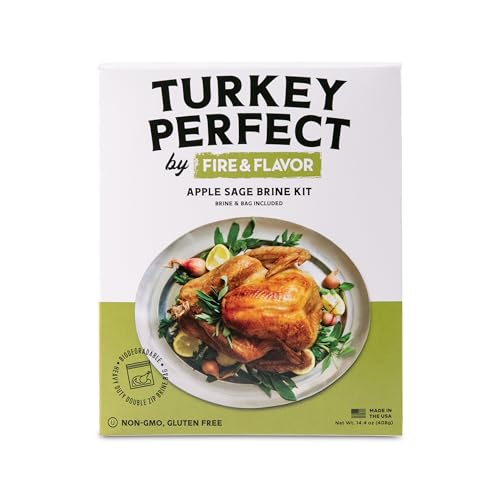
MAKE YOUR BEST TURKEY: In 5 simple steps, you'll have your best-tasting turkey ever. The brine ensures excellent flavor, and the bag keeps your turkey moist and tender. Our kit is gluten-free, non-GMO, and kosher.
Calculating Cook Time by Turkey Weight
Once you’ve completed your prep work and your smoker’s holding steady at 275°F, you’re ready to calculate exactly how long your turkey’ll spend on the grate. The formula’s straightforward: multiply your bird’s weight by 25 minutes per pound. A 12-pound turkey requires approximately 5 hours, while a 14-pound bird needs 5.5+ hours total.
In real world applications, actual cook times may vary slightly depending on your smoker’s consistency and the turkey’s thickness. Larger birds occasionally exceed the 25-minute baseline, so always verify doneness with a probe thermometer rather than relying solely on estimates. For optimal results, carve the breast off the wing to ensure even cooking throughout the bird.
This weight-based calculation gives you a reliable starting point, but internal temperatures—160°F breast, 175°F thigh—remain your ultimate guide for perfectly smoked poultry. Once your turkey reaches these target temperatures, consider raising the heat briefly to finish roasting the bird through to the final safe internal temperature of 165°F in the breast. An instant-read thermometer provides the most accurate way to monitor doneness throughout the smoking process. Insert the thermometer in the thickest part of the breast to get the most accurate reading for your turkey. After removing the turkey from the smoker, let it rest covered with foil for about 30 minutes before carving to lock in maximum juiciness. Resting the turkey loosely covered for 15-20 minutes helps redistribute juices throughout the meat.
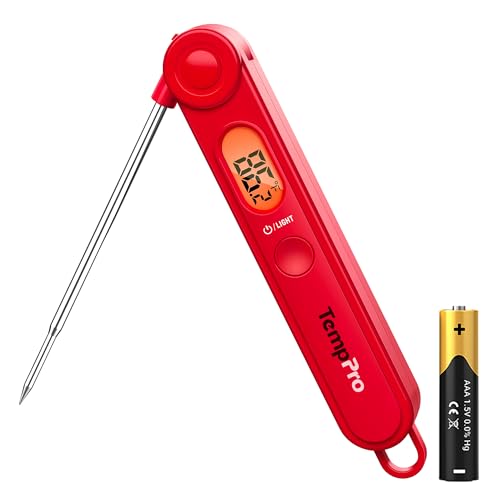
【Easy to Use】Easily release the meat probe at the push of a button, and control the backlight or power with another button. With TempPro, cooking becomes a seamless, stress-free experience

FAST 1-SECOND READ & ±0.9°F ACCURACY: Get temperature readings in just 1 second with ±0.9°F accuracy, so you can check doneness quickly and confidently. With a wide temperature range of -58°F to 572°F (-50°C to 300°C), this instant read meat thermometer is ideal for checking steaks, burgers, chicken, roasts, smoked meats, and more

No More Guesswork During Your Chill Cooking Time - professional digital thermometer devotes every beginner to becoming a prof! A good helper both in outdoor BBQ and Home party, It is the best gift for cooking enthusiasm and the useful kitchen gadget for festival meals
Monitoring Temperature Throughout the Process
Temperature monitoring makes or breaks your smoked turkey, and you’ll want to dial in your approach before that bird hits the grate. Invest in a wireless thermometer system with multiple probes to track both breast and thigh temperatures simultaneously. For probe insertion accuracy, position your sensing tip 1.5 inches deep into the thickest part of the breast, avoiding bone contact that produces false readings. Establish temperature monitoring protocols by confirming your thermometer calibration using ice water before smoking begins. Use your wireless system’s alerts to notify you when the breast reaches 165°F and thighs hit 175°F. Verify these readings with an instant-read thermometer when alarms sound, ensuring your turkey’s food safety without opening the smoker door repeatedly. For instant verification, consider a ThermoWorks Thermapen ONE with its ±0.5°F accuracy and 1-second read times to double-check your wireless probes. Remember that vegetative bacteria like Salmonella are killed at these cooking temperatures, making accurate thermometer verification critical for pathogen elimination. Look for wireless models with 300-foot range to monitor your turkey from indoors while maintaining signal strength throughout the cook. Top-performing options like the Fireboard Pulse deliver ambient temperature accuracy and extended range that outperform many competitors during long smoking sessions. For extended through-house coverage, consider systems using radio frequencies like 433/900 MHz instead of Bluetooth, which provide more reliable connectivity during long cooks. A wireless thermometer is essential equipment that will help you maintain consistent results and prevent undercooked poultry.

【700ft Long Range】Probe to Booster: 300ft for open cooking equipment, 6.6~33ft (2-10m) for enclosed cooking equipment (Note: Signal range is reduced in enclosed equipment due to metal shielding, resulting in shorter connection distances up to 33ft/10m); Booster to Smartphone: Up to 450ft via Bluetooth for reliable, extended monitoring.

Smart Display Base with Control: The ThermoMaven G1 wireless meat thermometer features a versatile smart display base that offers real-time temperature readings and allows you to set temperatures directly on the device—no app required. With our user-friendly one-click setup, you can connect the probe, pair it with the base, and start cooking in seconds—no complicated setup needed!

500FT Long Range: Compared with those Bluetooth meat thermometer on the market, this meat thermometer digital wireless equips itself with radio frequency technology that will ensure you stronger signal and more stable connection from up to 500FT
Resting and Carryover Cooking Process
As your smoked turkey reaches 165°F in the thickest part of the thigh, you’ve actually reached only the first checkpoint in the cooking process—not the finish line.
Remove your turkey from heat immediately and place it on a wire rack over your cutting board. Loosely cover it with aluminum foil for the next 20-30 minutes. During this critical resting period, carryover cooking raises your internal temperature another 5-10°F, reaching the perfect 165-168°F range for doneness. Many readers find the blog post tips helpful when planning their holiday cooking schedule.
This resting phase achieves two essential goals: juice leakage prevention and cooking quality enhancement. As residual heat redistributes through the meat, juices settle evenly throughout muscle fibers rather than escaping when you carve. Resist the temptation to cut until your full rest completes—patience locks in moisture and enhances flavor tremendously. Using a meat thermometer is crucial for verifying your turkey has reached the proper internal temperature before removing it from the smoker. Your turkey will stay good for up to 4 days in the refrigerator if you have leftovers after carving. For extended storage, freezing extends preservation substantially to 2-3 months or longer when vacuum-sealed. Just as with smoked turkey, proper storage is essential for maintaining quality and safety of any smoked meat. If you need to reheat your smoked turkey later, use a low temperature around 300°F with a little water or broth in a covered pan to maintain moisture. Covering tightly with foil during reheating helps trap steam and prevents the meat from drying out.
Moisture Retention and Quality Outcomes
The difference between a succulent, juicy smoked turkey and a dry, disappointing bird hinges entirely on your moisture-retention strategy throughout the smoking process. You’ll preserve moisture by preparing your turkey with a turkey brine solution for 24 hours beforehand—the salt actively helps retain water during extended heat exposure. At 275°F, you’re balancing speed with gradual moisture preservation. Pull your breast meat at 157-160°F to avoid overshooting the point where connective tissue toughens, while thighs reach 170°F for food safety. After smoking, you’ll achieve crispy skin texture through a brief 450-500°F finishing blast for 20-30 minutes. Using butter under the skin, maintaining a water pan, and avoiding excessive lid openings prevents surface drying. During the smoke, spraying with apple juice periodically helps maintain surface moisture and prevents the skin from drying out. For optimal results, brine your turkey for 48 hours in the refrigerator before smoking to maximize moisture retention throughout the extended cooking process. Consider using a Smoke X4 receiver to track breast and thigh temperatures with high alarms set appropriately, ensuring precise monitoring throughout the cook. Similar to smoking pork tenderloin, using wood pellets such as apple can enhance the flavor profile while maintaining moisture during the smoking process. After the initial smoking phase, you can wrap the turkey in foil with butter and brown sugar to add moisture enhancers that keep the meat juicy during the final cooking stage. To monitor doneness accurately, start checking the internal temperature around the expected finish time to prevent overcooking and ensure the meat stays moist. Once smoking is complete, allow the turkey to rest for 10 to 30 minutes so the juices can redistribute throughout the meat before carving. These techniques combine to deliver genuinely tender, flavorful results.