At 250°F, you’ll smoke a 12-15 lb brisket for roughly 7.5 to 8.5 hours until it reaches your target internal temperature. You’re looking at about 30-40 minutes per pound for whole brisket, though heavily trimmed cuts cook slightly faster. Wrap your brisket at 165-170°F to push through the stall phase, then continue until you hit 195-203°F for slicing. Don’t skip the essential resting period afterward—it’ll lock in moisture and transform your final result. There’s quite a bit more to master about achieving that perfect probe-tender brisket.
Basic Cooking Time at 250°F
Since you’re smoking at 250°F, you’ll cut your cooking time roughly in half compared to the traditional 225°F method, which means you’re looking at 30-40 minutes per pound for a whole brisket or 1.5 hours per pound if you’re aiming for sliced or pulled results.
Your cooking temperature adjustments profoundly impact total time on the smoker. A 12-15 pound brisket typically reaches tenderness in 7.5-8.5 hours at this temperature. Estimation accuracy factors include your specific smoker type—pellet smokers and offsets perform similarly at 250°F—plus your brisket’s exact weight and fat distribution. Monitor the internal temperature with a probe thermometer to ensure accurate tracking throughout the smoking process. For poultry alternatives like chicken quarters, smoking times are significantly shorter at 1.5 hours.
The 225-250°F range remains ideal for low-and-slow barbecue. Maintaining steady temperature throughout guarantees predictable results. You’ll reach your target internal temperature of 205°F for sliced brisket or 210°F for pulled brisket more efficiently than lower temperatures allow. During the process, you may encounter a temperature stall around 150-160°F where cooking slows due to moisture evaporation. After removing your brisket from the smoker, resting for 30 minutes allows the juices to redistribute for optimal tenderness. Consider using the Texas Crutch technique by wrapping your brisket in foil partway through cooking to retain moisture and potentially speed up the process. While smoking at 250°F reduces overall cooking time, be aware that the higher temperature may affect bark quality compared to the traditional 225°F method. For smoke flavor, use hardwoods like pecan or oak to complement the beef without overpowering it.
How Brisket Size Affects Cook Time
Your brisket trimming level also influences timing. Heavy trimming reduces effective thickness slightly, potentially shortening cook time on smaller cuts. Whole packer briskets take longer than separated flats because varying muscle thickness across sections extends the overall duration. The stall phase intensifies with larger, thicker briskets, potentially adding 2–4 hours or more to your total time. Consider selecting a non-packer cut for more manageable cooking times on your pellet grill. Brisket is naturally tough and requires low and slow cooking to break down collagen effectively, ensuring the connective tissues transform into tender, juicy meat. Using a water pan during the cook helps keep the meat moist and prevents it from drying out, especially when managing temperature fluctuations. For an average brisket flat of around 8-10 pounds, expect a total cook time ranging from about 8 to 10 hours when smoking at 250°F. As a general rule, plan for 1 to 1.5 hours per pound at 250°F to ensure your brisket reaches the proper tenderness without being rushed. Many pitmasters wrap their brisket once it reaches 165°F internal temperature to help push through the stall and preserve moisture during the final phase of the cook. After cooking, allow the brisket to rest for an hour or more before slicing to ensure optimal texture and flavor retention.
Temperature Comparisons for Different Heat Levels
When you’re ready to fire up your smoker, the temperature you choose fundamentally shapes your brisket’s journey from raw to tender.
At 225-250°F, you’re embracing the classic low-and-slow method, which allows connective tissue to break down gradually over 12-18 hours. This range creates ideal smoke density that penetrates deeply, rendering fat evenly throughout. For perfect brisket thickness around 12-14 pounds, expect 14-16 hours at 225°F, targeting 195-203°F internal temperature. Using a quality remote thermometer can help ensure you’re accurately monitoring your brisket’s progress throughout the cook. Always trim the fat cap down to an even 1/4-inch layer before smoking to ensure even heat penetration and rendering.
Conversely, pushing to 300°F cuts your cook time in half while maintaining tenderness at 205-210°F. You’ll mist every 30 minutes and probe frequently after the initial 2-2.5 hours. For serious pitmasters demanding the highest precision, consider an instant-read thermometer with ±0.5°F accuracy and 1-second read times to verify doneness across different sections of the brisket. Many grillers prefer radio-frequency thermometers over Bluetooth models for superior through-house range during extended smoking sessions. Some multi-probe Wi-Fi systems allow you to monitor multiple temperature points remotely throughout your entire cook.
Regardless of your chosen temperature, you’re aiming for that same final pull temperature: 195-205°F. The method you select depends on your schedule and equipment. Because briskets can experience a stall phase where the internal temperature plateaus due to evaporative cooling, total cooking time may extend beyond initial estimates. Adding a water pan to your smoker helps retain moisture throughout the cooking process, ensuring your brisket stays juicy and tender.

Fast & Accurate: Get precise readings in just 1 second with ±0.9°F accuracy. NSF Certified for trusted food safety, this digital food thermometer features a 4.3 inches food-grade stainless steel meat probe, perfect for grilling, frying, baking, making candy and more

Instant Read Meat Thermometer | Our instant read thermometer features a temperature probe and advanced, highly accurate technology with a 1-2 second response time. Our instant read food thermometer comes pre-calibrated with instructions and a meat temperature chart, plus a recalibration feature if needed.

【Fast & Accurate】Our meat thermometer digital delivers accurate readings within ±1°F in just 1–2 seconds, with a wide temperature range of -58°F to 572°F (-50°C to 300°C). No more waiting over the heat - know your food's exact temperature instantly.
The Unwrapping and Wrapping Strategy
Once your brisket hits that 165-170°F sweet spot—what pitmasters call “the stall”—it’s time to make a strategic choice that’ll dramatically affect your final result. Ideal wrap timing at this temperature prevents your meat from drying out during the remaining cook. You’ve got two solid options: butcher paper or foil. Butcher paper lets steam escape while preserving that coveted crispy bark, making it the choice of legendary pitmasters. Foil traps heat and moisture completely, shortening your cook via the Texas Crutch method. Wrap tightly without gaps, fold the open side down, and return your brisket to the smoker. The porous nature of butcher paper allows heat and air to penetrate more effectively than foil, resulting in a superior crust while still retaining enough moisture for tenderness. Some pitmasters use a naked cooking method where the brisket remains unwrapped throughout to develop maximum bark texture. Temperature control is managed by adjusting the grill’s vents, which regulate airflow to control the charcoal’s burn rate and thus the amount of heat generating radiation and convection within the grill. Monitoring moisture levels throughout this phase guarantees you’ll pull tender, juicy meat that’s worth the wait. Quality charcoal grills with superior heat retention capabilities maintain consistent temperatures during these extended smoking sessions, which is essential for achieving optimal results.

Designed specifically for the culinary enthusiast, our 18 paper roll dispenser is optimally crafted to handle barbecue butcher paper, thereby ensuring the authentic taste of your smoked meats is maintained. This is your ideal bbq wrapping paper for smoking

【PREMIUM NATURAL QUALITY】Made from premium virgin pulp, our butcher paper is unwaxed, uncoated, and unbleached for a natural and pure product. Ideal for grill masters seeking top-notch, food-safe paper to enhance their culinary creations.
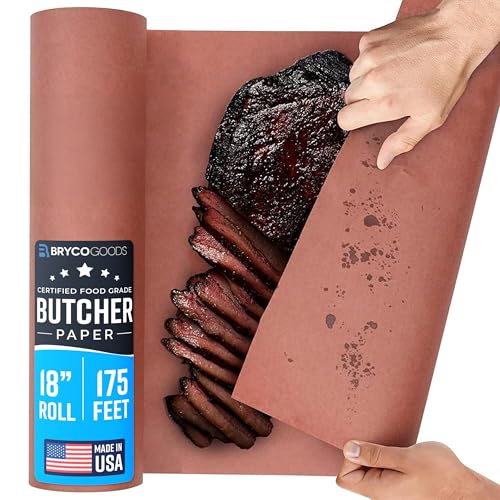
Butchers Paper is ultra durable and strong; does a superior job trapping smoke while releasing steam
Achieving Probe Tender Perfection
The real test of a perfectly smoked brisket isn’t what the thermometer says—it’s how the meat feels. Your probing techniques matter more than temperature alone. Start checking the thickest part of the flat around 190°F, inserting your probe like pushing through butter—it should slide in and out effortlessly with zero resistance. You’ll notice the point reaches tenderness first, often at 190°F, while the flat requires closer to 195°F. Check multiple spots since thickness varies markedly across the brisket. The flat is particularly important to focus on since it is the most challenging part to render tender compared to the point’s higher fat content.
Once you’ve achieved that butter-like texture, implement proper resting techniques immediately. Wrap your brisket and let it rest for an hour post-probe tender. This vital step locks in moisture and prevents the thin sections from drying out or becoming tough during slicing. Similar to achieving a juicy interior in bratwurst, maintaining proper moisture throughout the cooking process ensures your brisket stays tender. Just as the reverse-sear technique ensures perfectly tender steak, proper resting maximizes the juiciness of your finished brisket. Experience proves that monitoring with quality gauges like Thermoworks or Meater helps you identify the exact moment your brisket transitions from perfectly cooked to overdone, ensuring consistent results across multiple cooks. For hands-off monitoring throughout the long cook, wireless probes with apps provide precision without constant manual checks. Maintaining PID temperature control within a tight range of just 5 degrees creates the ideal low-and-slow environment that produces consistently tender results. Just as preheating the grill is essential for even cooking on a George Foreman, proper temperature management from the start ensures your brisket cooks uniformly throughout.

Ultra-Long Wireless Range:Monitor your food from up to 3000 feet away with Sub-1G wireless technology, which has stronger penetration than bluetooth and delivers signals more stably. Perfect for outdoor BBQs, grilling, or large kitchens, giving you freedom to move without missing a temperature change.

More Stable Than Bluetooth: Our advanced RF technology ensures a stronger, more reliable connection than Bluetooth. This smoker thermometer provides the freedom to move around without losing connection! Monitor your BBQ from up to 1,000 feet away!

Smart Display Base with Control: The ThermoMaven G1 wireless meat thermometer features a versatile smart display base that offers real-time temperature readings and allows you to set temperatures directly on the device—no app required. With our user-friendly one-click setup, you can connect the probe, pair it with the base, and start cooking in seconds—no complicated setup needed!
Internal Temperature Targets and Doneness
While probe tenderness gives you the tactile feedback you need, internal temperature remains your essential roadmap to perfectly smoked brisket. You’re aiming for an ideal internal temperature between 195°F and 205°F, with 200°F hitting the sweet spot for most pitmasters.
This temperature range isn’t arbitrary—it’s where connective tissue breakdown reaches completion. Collagen transforms into gelatin during your low-and-slow cooking process, but you need sustained heat exposure to accomplish this transformation fully. You’ll notice tissues begin softening around 195°F, then achieve complete tenderness by 200-210°F. Smoking meat at 225-275°F allows for this connective tissue breakdown to occur properly. A resting period after reaching target temperature allows juices to redistribute, ensuring your finished brisket remains moist and flavorful. Similar to smoking ribs, you can use visual cues like bark development and fat rendering alongside temperature readings to assess doneness. Unlike hot and fast methods that finish ribs at 300°F in under 2.5 hours, brisket requires extended time at lower temperatures for proper connective tissue transformation.
Don’t rely solely on temperature readings, though. You’re combining thermometer data with probe tenderness checks across multiple spots in the flat. Using a meat thermometer throughout the cook ensures you’re tracking temperature accurately and avoiding underdone or overcooked sections. Monitor your brisket’s internal temperature with a thermometer rather than relying solely on time, just as you would track the thickest part of poultry to ensure safety. A reliable thermometer is essential for monitoring your brisket’s progress from start to finish. This dual-method approach guarantees you’re pulling your brisket at peak doneness, delivering maximum flavor and moisture retention.

Longer Range 650 ft: The built-in best-in-class Bluetooth chip empowers this Bluetooth thermometer a longer range of up to 650 ft, a stronger signal and more stable connection to the smart App; so you'll never lost contact with your food no matter where in your house or yard

BBQ HI/LOW temp range alarm: Set your desired food temp and HI/LOW temp range for your grill or smoker to know when to add more fuel smoker thermometer will flash and beep to remind you if the temperature ever goes out your set range; HI/LOW temp range alarm is specifically designed for usage with smokers, grills and BBQs

Bluetooth Monitor Remotely: Govee Bluetooth meat thermometer lets you check the temperature of your grill, smoker, or oven from your phone. With this smart BBQ thermometer, you can multitask while grilling.
Managing Temperature Fluctuations
Now that you’ve nailed your target temperature and know how to check for probe tenderness, you’ll reveal that maintaining a rock-solid pit temperature is equally challenging—and equally crucial.
You’ll want to set low and high alarms at 225°F and 275°F respectively, creating a manageable swing around your 250°F target. Don’t panic when you see fluctuations—offset smokers handle swings up to ±100 degrees through convective heat distribution. Focus on maintaining airflow consistency by adjusting vents strategically, and stay vigilant about monitoring fuel replenishment when temperatures dip toward your low alarm. Remember that temperature swings are normal in smokers and should not be a source of concern, just as they occur naturally in kitchen ovens without ruining the food.
Use quality thermometers to track actual pit temps continuously, identifying hot spots for ideal meat placement. Rotate your brisket every two hours, positioning the thicker point end toward the firebox for balanced exposure throughout the cook. A humid environment in your smoker will help slow moisture evaporation and support better smoke penetration during these rotations. If you’re using a pellet grill, you can adjust the auger speed settings to fine-tune temperature control based on ambient conditions. Keep the grill lid closed as much as possible to stabilize temperature and prevent unnecessary heat loss between monitoring sessions. Regular maintenance, including removing grease buildup from your smoker, helps ensure consistent temperature control and prevents potential flare-ups during long cooks. While brisket requires low and slow cooking at 250°F, understanding the 300 to 400 degree range for medium heat grilling can help you manage finishing touches or searing after the smoke. Proper coverage and cleaning of your smoker after each use will extend its lifespan and maintain optimal performance for future cooks.
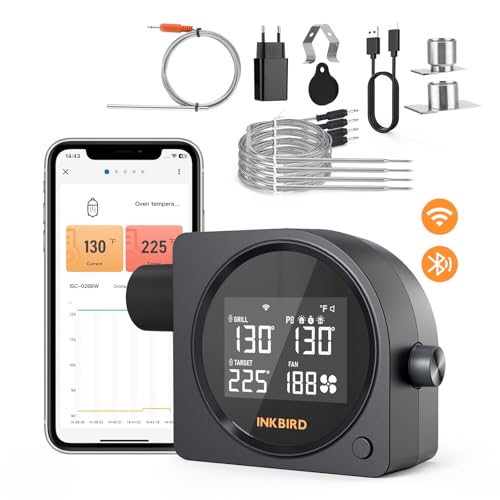
【5G Wi-Fi & Bluetooth5.0 Mode】Inkbird smoker controller fan supports two networking methods;can monitor the grill through smartphone; one smartphone can control multiple smoker controllers at the same time, or multiple people can monitor one smoker controller.
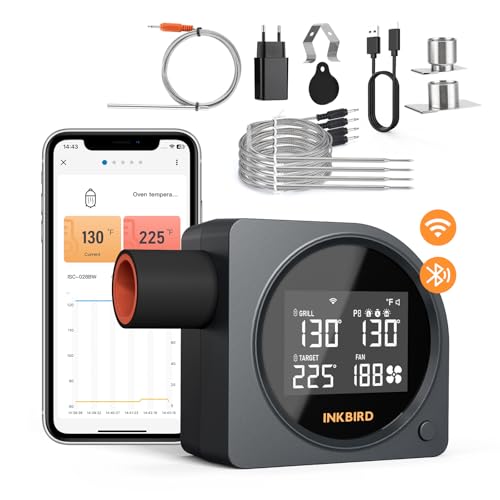
【5G Wi-Fi & Bluetooth5.0 Mode】Inkbird smoker controller fan supports two networking methods;can monitor the grill through smartphone; one smartphone can control multiple smoker controllers at the same time, or multiple people can monitor one smoker controller.

【2.4GHz Wi-Fi & 5.0 Bluetooth Suppor】Bluetooth 5.0 function and supports 2.4GHz Wi-Fi networking, which can control and monitor the grill from smartphone. One smartphone can simultaneously control multiple controllers, and several people can monitor the same controlle.
Resting Your Brisket After Smoking
Your perfectly smoked brisket isn’t quite ready for the cutting board yet—you’ve got to let it rest. The ideal resting duration falls between 2-3 hours, though you can get acceptable results with a minimum of 1 hour if you’re pressed for time.
During smoking, heat forces moisture toward the surface and pressure builds inside the meat. Resting allows that pressure to decrease, letting your brisket retain juices better. The cooling process also stabilizes the meat’s structure, making it much easier to slice cleanly without crumbling. This redistribution of juices ensures that every slice of the brisket will have optimal juiciness throughout.
For supreme brisket resting conditions, wrap your brisket in foil and place it in a cooler lined with towels. This setup maintains temperature gradually, giving you flexibility in your serving window. Similar to how ribs benefit from wrapping in foil during the cook, this technique helps lock in moisture and promotes tenderness. You’ll notice vastly improved juiciness and texture compared to slicing immediately after smoking. Rather than relying solely on time, you can check for doneness by testing how easily a probe penetrates the meat, which provides a more reliable indicator of tenderness. If you need to rest your brisket longer, ensure you monitor the temperature to keep it out of the danger zone and maintain food safety. Once you’re finished with your grill, remember to safely extinguish any remaining coals by closing all vents and the lid to cut off the oxygen supply. After your smoker has completely cooled down, consider using a waterproof cover to protect it from weather damage and extend its lifespan. Regular cleaning of your drip pans prevents dangerous grease fires and keeps your smoker performing at its best for future cookouts.
Factors That Impact Your Final Results
Your meat quality selection fundamentally determines your outcome. Choosing USDA Choice or Prime grade guarantees superior marbling, which directly prevents dryness and delivers richer flavor. That fat content isn’t a liability—it’s your assurance for moisture retention.
Temperature consistency matters enormously. Even slight fluctuations create uneven cooking and dry spots. Minimize lid lifts and maintain steady heat between 225-250°F.
Your wood selection and smoke management create the flavor foundation. Thin blue smoke beats thick white smoke every time, and properly aged hardwoods like post oak deliver dramatically superior results compared to fresh wood. Lump charcoal combined with hardwood chunks like oak or hickory further enhances the depth and complexity of your smoke profile. The Maillard reaction between the meat’s proteins and the smoke compounds creates the complex flavors and brown crust that distinguish exceptional brisket. Premium options like B&B or Jealous Devil provide consistent temperature control and minimal ash production throughout your extended smoking session. Red oak stands out as the “king of hardwoods” for its slow burn and versatility, making it an excellent choice for smoking brisket alongside fruitwood additions. For robust, bacon-like smoke flavor, hickory wood chips deliver strong intensity that pairs exceptionally well with beef when used at 1/2 to 1 cup per hour. Premium wood pellet brands like Lumberjack and Bear Mountain BBQ offer 100% natural hardwoods with no fillers, delivering consistent hickory and cherry smoke for extended low-and-slow cooking sessions.
Finally, wrapping timing impacts your bark development and final texture. For offset smokers requiring extended heat duration, briquettes offer consistent medium temperature and longer burn times compared to lump charcoal’s hotter but shorter performance. Each decision compounds, so mastering these variables transforms your results substantially.