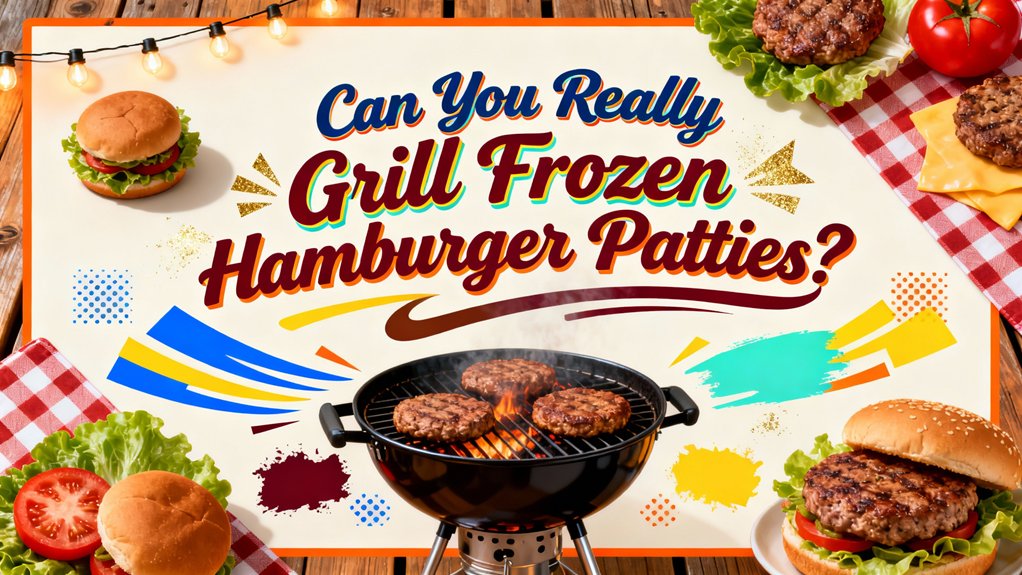
You can grill frozen hamburger patties, but you’ll encounter significant challenges. Your exterior’ll char before interiors thaw properly, and you’ll struggle with inconsistent doneness and flare-ups on open-flame grills. The USDA requires 160°F internal temperature for food safety, which demands constant monitoring. Thawing patties first delivers superior crust formation, quicker cooking, and juicier results with a flat-top griddle’s consistent heat distribution. Uncover the specific techniques and equipment strategies that transform your grilling results.
Understanding Food Safety Requirements for Ground Beef
Why’s food safety essential when you’re grilling frozen hamburger patties? You must reach an internal temperature of 160°F to destroy harmful bacteria and pathogens effectively. Using a food thermometer verifies you’ve achieved this critical threshold, whether your patties are frozen or thawed. This temperature requirement applies consistently across all ground beef products.
Your proper cooking time depends on patty thickness and heat intensity, but the internal temperature remains non-negotiable. Don’t rely on visual cues or cooking duration alone. Insert your thermometer into the thickest part of the patty, ensuring accurate readings. The USDA established this 160°F standard specifically to eliminate foodborne illness risks. Following these guidelines protects you from E. coli O157:H7 and other dangerous pathogens. For best quality results, ground beef should be used within 1-2 days if storing in the refrigerator before cooking. Casseroles and mixed dishes containing ground beef require an even higher 165°F minimum. Position your grill in a well-ventilated outdoor space to ensure proper airflow and safety during cooking. When grilling from frozen, expect your total cooking time to increase by approximately 50% compared to thawed patties. Before you start cooking, inspect your grill grates and remove any rust buildup by scrubbing with a grill brush to ensure food safety and prevent metallic off-flavors. Avoid covering your grill grates with aluminum foil, as high temperatures can cause aluminum particles to leach into your food and pose potential health risks. Clean your burner tubes gently with a brush to remove debris and ensure even heat distribution across the cooking surface. Following these guidelines protects you and your guests from potentially serious health consequences.
Why Traditional Grills Aren’t Ideal for Frozen Patties
Now that you understand the temperature requirements for safe ground beef consumption, you’ll find that traditional open-flame grills present significant practical challenges when cooking frozen patties. Open flames create inconsistent heat application across the cooking surface, with patties experiencing alternating exposure to direct flame and cooler metal grates. This unpredictable cooking results in exterior charring before interiors thaw adequately. Frozen patties weren’t engineered for flat-top cooking, which distributes heat evenly.
Additionally, you’ll encounter increased flare-up risks as frozen fat renders unevenly, causing flame bursts that further char exteriors. The interval between hot metal bars leaves portions undercooked while others burn. You’d need constant temperature monitoring and adjustment to achieve the 165°F internal standard safely, making traditional grills inefficient for frozen burger preparation. A two-zone fire setup can help mitigate these challenges by allowing you to sear patties over direct heat before moving them to indirect heat for thorough cooking. Using a cast iron griddle on your grill can significantly improve heat distribution and cooking consistency compared to direct grate exposure. Scrubbing grill grates with a brush before preheating also helps ensure more uniform heat transfer to your frozen patties. Heavy cast iron delivers superior heat retention that maintains consistent temperature even when frozen meat is placed on the surface. For optimal results, preheat your cast iron surface to a high temperature before adding the frozen patties to ensure proper searing. The tall ridges on cast iron grill pans create defined grill marks while maintaining excellent contact with the meat for consistent cooking. A stovetop grill pan with raised ridges offers another effective alternative, combining the heat retention of cast iron with the convenience of indoor cooking and easier temperature control.

【2-in-1 Reversible Grill & Griddle】: Unlock a world of recipes with a single reversible griddle pan. One ribbed side creates perfect sear marks on steaks, chops, fish, chicken, and veggies; flip to the smooth side for pancakes, eggs, bacon, burgers, tortillas, and more. Ideal for indoor stovetop or outdoor BBQ

Double Burner Configuration: The Lodge Double Play Reversible Cast Iron Grill/Griddle covers two burners, offering a generous breakfast grill plate for family breakfasts or meal prep with ease

Steakhouse Sear At Home: The Lodge Square Cast Iron Grill Pan delivers high-heat searing and bold grill marks while channeling excess grease away
The Equipment Mismatch: Flat Top Versus Open Flame Grills
Two fundamentally different cooking surfaces create distinct thermal environments that directly impact how frozen patties cook. You’ll find that flat top griddles capture heat within solid material, delivering even cooking surface control across the entire cooking area. Their U-shaped burners reach up to 600°F while eliminating hot spots that plague traditional setups.
Open flame grills, conversely, rely on direct flame heat requirements that create uneven temperature zones. Heat rises through suspended grates, generating intense but inconsistent hot spots that freeze solid patties struggle to navigate evenly. The evolution from flame heat to versatile flattop grill technology demonstrates how independent heat adjustment across cooking zones enables superior results for frozen applications. Griddles provide direct, full-surface contact that ensures consistent searing across the entire patty surface.
For frozen hamburgers, you need predictable thermal distribution. Flat tops excel here, providing consistent full-surface contact that thaws and cooks patties uniformly. Modern griddles like the Solo Stove Steelfire offer 486 square inches of cooking surface with dual burners delivering 24,000 BTUs for optimal heat distribution. Open flame grills expose frozen centers to variable temperatures, resulting in exterior char before interior thawing completes properly. Superior grease management systems on quality griddles also prevent frozen patty moisture from creating flare-ups or pooling issues during the cooking process. Premium models feature carbon steel tops that retain heat efficiently and develop natural non-stick surfaces over time. Cast iron griddles offer exceptional heat retention for consistent searing performance when working with frozen proteins. Electric flat top models with removable plates simplify cleanup after cooking frozen patties that release excess moisture during the thawing process.

【SAFE-TO-USE COOKWARE】Crafted with pure iron and oil, just as traditional seasoned cast iron should be — our cookware is free of harmful PFOA and PTFE. We’re dedicated to creating products that keep you and your loved ones safe: every stage of our manufacturing process prioritizes the well-being of our employees and our customers.

EXTRA-LARGE COOKING SURFACE: The 10 x 20 inch indoor grill provides plenty of space to cook up big batches for a crowd or a complete meal.

✅ Special Notes for this item: If you are looking for parts, the BRAND and MODEL No.# listed below are just for your reference. Please Kindly check again for the SIZE and MODEL of your original parts before purchasing. if you have any problem with the item, please feel free to contact us 7 * 24 Hours, We will reply to you within 24 hours and give you a satisfactory solution.
Step-by-Step Guide to Grilling Frozen Burgers
Understanding your equipment’s thermal characteristics sets the stage for proper execution, and the methodology you’ll follow determines whether those frozen patties cook evenly or unevenly. You’ll start by seasoning both sides with Kosher salt, then place patties on indirect heat for ten minutes undisturbed. This initial phase prevents scorching while controlling cooking time effectively. Minimal handling reduces the risk of bacterial growth during this preparatory stage.
Once juices accumulate on top, you’ll flip once—only once—to retain moisture and maximize flavor. Season the second side immediately. Cook another four to six minutes until reaching 160°F internally. You’ll avoid pressing down, which squeezes out valuable juices and fat. Using a meat thermometer helps verify you’ve reached safe internal temperatures for consumption. Internal temperature is the most reliable indicator for doneness rather than relying solely on cooking time. Avoid pressing down on patties during cooking to retain juices and prevent the meat from becoming dry. For extra juiciness, consider placing an ice cube in the center of thicker patties before grilling, which melts slowly to release moisture into the meat.
Move patties to indirect heat post-flip to prevent flare-ups. Add cheese on cooler zones for even melting. Preheating your grill to around 375°F ensures consistent heat distribution for optimal cooking results. Oiling the grill grates before cooking helps prevent the patties from sticking to the surface. Finally, rest your patties briefly before serving, ensuring ideal texture and taste.

One 6 count package of Ball Park Fully Cooked Flame Grilled Beef Patties


100% Grass Fed Beef Burger Patties: Made with pasture-raised, grass-fed and grass-finished beef for rich, natural flavor.
Common Cooking Mistakes That Compromise Quality
Even when you’ve mastered the fundamentals, subtle errors can derail your results and transform promising frozen patties into disappointing meals. You’ll compromise quality by pressing patties with your spatula, which squeezes out essential fats and juices. Flipping too frequently prevents proper crust formation, leaving you with tough, dry meat. Improper patty formation—overworking ground beef or using lean meat instead of 80/20 chuck—undermines texture from the start. Neglecting a meat thermometer risks undercooking, creating food safety hazards below 160 degrees Fahrenheit. Without moisture retention strategies, excess ice crystals turn patties rubbery. You’ll also struggle if you skip preheating, causing patties to stick and break apart. Proper seasoning before grilling enhances flavor development and creates a more flavorful crust. Using oils with high smoke points prevents burning and helps achieve better browning on frozen patties. Refined options like avocado or canola oil are particularly effective for high-heat grilling due to their elevated smoke points and neutral flavors. A crisp, caramelized crust is essential for achieving the ideal burger texture and flavor profile. Applying grill cooking spray before placing patties prevents sticking and creates better grill marks without compromising flavor. Managing flare-ups by moving burgers away from direct flames helps prevent charring while maintaining optimal cooking temperature. These preventable mistakes transform potentially excellent frozen burgers into substandard results.

Graza Frizzle Oil Made from 100% Olives: A neutral-flavored, high heat cooking oil made from 100% peak harvest olives. With a smoke point of up to 450 degrees, Frizzle is your high-heat kitchen hero. 1 bottle/750ml.

Graza Frizzle Oil Spray Made from 100% Olives: A neutral-flavored, high heat cooking oil made from 100% peak harvest olives. With a smoke point of up to 450 degrees, Frizzle is your high-heat kitchen hero. 1 can/5 oz.

Light Buttery Flavor That Elevates Every Meal: Algae Cooking Club Chef-Grade Algae Oil enhances every dish with subtle richness. Its neutral profile makes it ideal for searing, baking, and dressings, transforming everyday meals into gourmet experiences.
The Case for Thawing Before Grilling
While avoiding these common pitfalls requires discipline, you’ll find that thawing your patties before grilling eliminates most of these challenges altogether. Thawed patties enable superior crust formation through efficient searing, whereas frozen patties steam initially and lose depth of flavor. You’ll achieve better flavor development when you season thawed meat properly—surface seasoning adheres more effectively than on frozen surfaces. Additionally, thawed patties cook markedly quicker, reducing exterior overcooking risks while maintaining interior juiciness. Freezing patties using the freezer trick can make your burgers even juicier by creating optimal ice crystal distribution throughout the meat. Cooking frozen patties directly on a flat-top griddle provides consistent, controlled heat that prevents uneven cooking and helps retain moisture and seasonings. You’ll reach the critical 160-degree Fahrenheit safety mark more predictably with consistent heat penetration. Temperature monitoring becomes straightforward, eliminating complex indirect-to-direct heat shifts. Using a meat thermometer ensures you achieve the safe internal temperature of 160°F without the guesswork that comes with cooking frozen patties. Relying on an instant-read thermometer instead of color alone is essential, as the cooking method can affect meat appearance even when fully cooked. For even greater precision, consider a wireless grill thermometer that lets you monitor internal temperature from inside your house without constantly lifting the grill lid. For those who prefer smashed burgers, a quality hamburger press can help achieve uniform thickness and optimal searing surface area, whether working with fresh or thawed patties. A cast-iron press delivers the heavy weight needed for professional-style smashing and superior sear development on thawed patties. By thawing first, you gain complete control over your grilling process, ensuring superior texture, appearance, and food safety with minimal complications.
Navigating Conflicting Package Instructions
You’ll encounter a fundamental disconnect between manufacturer guidance and grilling best practices when you’re deciding whether to thaw your patties first. Package discrepancies exist because manufacturers prioritize structural integrity—fully-cooked patties specify frozen grill guidance to prevent disintegration during handling and placement. However, user forums consistently report that thawing yields superior results, preventing interior overcooking while achieving even doneness. Raw frozen patties require grilling to 160°F from frozen, complicating temperature management. The distinction between fully-cooked and raw products further muddles recommendations. Frozen burgers do not need to be thawed before grilling, as frozen burgers stay together better when placed directly on the grill without thawing. According to package instructions, these fully-cooked patties can be warmed on the grill over medium heat for 6-8 minutes when frozen. When setting up your grilling station, ensure you maintain proper clearances from combustible materials to prevent fire hazards. Before lighting your grill, always verify that the gas supply valve is properly positioned to control propane flow safely. Just as temperature control is critical for vertical pellet smokers achieving consistent results in all weather conditions, managing heat zones on your grill ensures frozen patties cook evenly without burning exteriors or leaving cold centers. For smaller batches of burgers, you can achieve excellent results using fewer burners on a multi-burner gas grill, which improves both heat management and fuel efficiency. Whether you’re using a full-size home grill or a portable gas grill designed for camping and tailgating, the principles of heat management remain essential for cooking frozen patties effectively. Your best approach: follow package instructions for fully-cooked products prioritizing convenience, but consider thawing raw patties for superior texture and consistent results. Understanding these package discrepancies helps you make informed decisions aligned with your specific product type and desired outcome.
Using a Thermometer to Ensure Safe Results
A food thermometer isn’t optional when grilling frozen hamburger patties—it’s your most reliable tool for verifying that harmful bacteria have been destroyed and your patties are safe to eat. Insert an instant-read thermometer into the thickest part of each patty, checking internal temperature monitoring consistently during cooking. For ground beef, you’re targeting 160°F; ground poultry requires 165°F. Patty thickness considerations matter substantially here—thicker patties need longer cooking times, making frequent temperature checks essential. Avoid pressing patties while checking, as you’ll lose valuable juices. After flipping on a two-zone setup, verify temperature again to confirm even cooking. For quick and accurate readings, consider investing in a quality instant-read thermometer like the Thermapen ONE, which provides precise temperature measurements in just one second. If you prefer hands-free monitoring during longer grilling sessions, wireless meat thermometers with app connectivity allow you to track temperatures without constantly opening the grill lid. Budget-conscious grillers can achieve reliable results with options like the ThermoPro TP20, which offers dual-probe functionality and a 300-foot range for monitoring multiple patties simultaneously. Using a meat thermometer inserted in the thickest part ensures you achieve proper doneness without overcooking, a technique that works for all types of grilled proteins. Once your patties reach the target temperature, let them rest two minutes before serving, ensuring safe, juicy results every time. Frozen hamburgers are perfect for any occasion, so mastering proper temperature verification will make you confident in serving them to family and friends. Whether you’re using a budget-friendly CharBroil or a premium model with infrared burners, consistent heat distribution helps frozen patties cook more evenly to the target temperature.

Fast & Accurate: Get precise readings in just 1 second with ±0.9°F accuracy. NSF Certified for trusted food safety, this digital food thermometer features a 4.3 inches food-grade stainless steel meat probe, perfect for grilling, frying, baking, making candy and more

【Fast & Accurate】Our meat thermometer digital delivers accurate readings within ±1°F in just 1–2 seconds, with a wide temperature range of -58°F to 572°F (-50°C to 300°C). No more waiting over the heat - know your food's exact temperature instantly.

【8X Faster + 4X More Precise】: Upgraded with an industrial-leading professional thermocouple sensor, Themomonster meat thermometer digital with NIST certified ±0.5℉ precision provides you the accurate temperature of your food in just 0.5 Seconds.