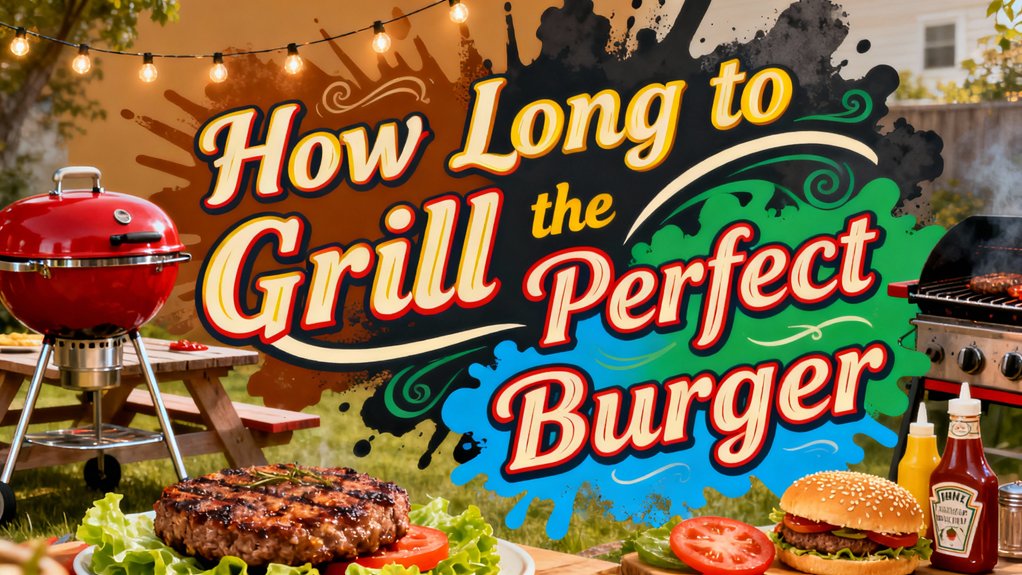
You’ll grill the perfect burger in 6 to 8 minutes at 375-400°F using the single-flip method. Start with a quarter-pound patty at room temperature, sear it directly over heat, then flip once halfway through. Pull it off when you’ve reached your target internal temperature: 120-130°F for rare, 130-135°F for medium-rare, or 140-145°F for medium. Let it rest briefly before serving to retain those precious juices. The specific timing and techniques that’ll elevate your burger game await you.
Preparing Your Patties for Success
Before you fire up the grill, you’ll want to get your burger patties right—and that starts with selecting quality ingredients and mixing them correctly. Combine two pounds of ground chuck with ½ cup crushed saltine crackers, one egg, and two tablespoons Worcestershire sauce. Add salt, garlic powder, onion powder, and black pepper for depth. Mix minimally by hand to avoid developing a dense, rubbery texture.
Form quarter-pound patties using a plastic wrap-lined lid as your handling method for consistency. Press a slight indentation in each patty’s center to prevent puffing during cooking. Make them slightly larger than your bun to account for shrinkage. This simple jar lid technique allows you to create professional-looking burgers with uniform size and shape every time. The milk and egg in your mixture will bind all the ingredients together for sturdy patties that hold up well on the grill. For smashed-style burgers, a cast-iron burger press delivers superior results by creating maximum contact with the cooking surface.
For freezing options, stack patties with wax paper between layers. Refrigerate finished patties for at least one hour prior to grilling to guarantee they hold their shape perfectly. To keep thicker burgers extra juicy, try placing an ice cube in the center of each raw patty, which will melt during cooking and release moisture into the meat. Before placing burgers on the grill, oil the grates or lightly brush the patties themselves to prevent sticking during cooking. Consider using non-stick grill mats as an alternative that simplifies cleanup and prevents flare-ups while still allowing grill marks to form. Make sure your grill is preheated to around 375°F before you begin cooking for optimal results.

【HEAVY-DUTY CAST IRON GRILL PRESS】 :Our barbeque grill press is made of heavy duty food grade cast iron. Use the grill weight to press out unwanted grease and fat, safe to use in the oven, on the stove, on the grill, griddle, or campfire. The press can also be seasoned like cast-iron skillets to create a non-stick surface.

Pre-Seasoned: Our cast iron hamburger press is professionally pre-seasoned, so after use, simply clean it and wipe it dry, or place it directly in the dishwasher

🍳𝙁𝙤𝙤𝙙-𝙂𝙧𝙖𝙙𝙚 𝘾𝙖𝙨𝙩 𝙄𝙧𝙤𝙣 𝙋𝙧𝙚𝙨𝙨- Made from fluorine-free cast iron and pre-seasoned for nonstick performance and rust resistance. The heavy weight creates crispy, caramelized crusts, while the flat bottom ensures even heat distribution and professional grill marks. Features a heat-safe wooden handle with an ergonomic grip. At 6.5”, it fits over 95% of stovetops—ideal for both indoor kitchens and outdoor grills.
Setting Up Your Grill to the Right Temperature
With your patties prepped and chilled, you’re ready to focus on the other half of burger success: your grill’s temperature. Target 375-400°F for gas and charcoal grills, or 450°F for pellet grills. Allow adequate grill preheating duration before placing burgers—rushing this step compromises your sear. Built-in thermometers often mislead, so invest in an external thermometer for reliable temperature monitoring methods. Once stabilized, position your grates directly over the heat source with the lid closed. Brush grates clean to prevent sticking and maintain consistent heat contact. This direct-heat setup creates the browning and crust development that defines a properly grilled burger. Using a meat thermometer ensures you can accurately verify your grill has reached the target temperature and maintain it throughout the cooking process. For spotting uneven heat distribution across your cooking surface, an infrared surface thermometer helps identify hot zones before you place your burgers. For charcoal grills, keep the lid closed between checks to stabilize temperature and prevent heat fluctuations that affect cooking consistency. Gas grills with durable cast-iron grates provide superior heat retention and more reliable searing compared to standard grate materials. Remember that internal temperature is the most reliable indicator for doneness, so monitor your burgers throughout the cooking process rather than relying solely on time. Temperature precision during this setup phase directly determines your final result, allowing you to confidently cook burgers to your desired internal temperature. For enhanced safety when handling your grill, always use oven mitts and high-heat-resistant utensils to protect yourself from burns.
Cooking Times Based on Desired Doneness
How long should you cook your burger? It depends on your desired doneness and ideal patty thickness. For proper patty formation, aim for ½ to ¾-inch thickness, which greatly affects cooking times.
Rare burgers need 4-6 minutes total, reaching 120-130°F. Medium-rare requires 5-7 minutes for 130-135°F, while medium burgers take 6-8 minutes at 140-145°F. Medium-well demands 7-9 minutes, hitting 150-155°F. Well-done burgers require 8-10+ minutes to reach the USDA-recommended 160°F minimum. Remember that fresh hamburgers cook quicker than frozen patties, so adjust your timing accordingly if using frozen burgers.
Thicker patties naturally need additional time. A ¾-inch burger requires roughly 2 extra minutes compared to a ½-inch patty across all doneness levels. To prevent flare-ups and ensure even cooking, create dual cooking zones on your grill before placing patties. When grilling frozen patties directly, avoid pressing down on burgers to retain juices and prevent dangerous flare-ups. Use an instant-read thermometer to verify internal temperatures, ensuring you achieve your preferred doneness consistently. Insert the thermometer into the thickest part of the burger to get the most accurate reading and avoid undercooking. For those seeking a smoky flavor profile, consider smoking burgers at 225°F for 60 to 90 minutes before searing at high heat to develop a flavorful crust. Using ground beef with at least 15% fat content helps prevent the patties from drying out during the smoking process. Preheat the grill to about 375-400°F before placing your burger patties directly over the coals for optimal searing.

One 16 ounce package of 100% Pure Ground Beef, 80% Lean/20% Fat

Three individually sealed 16 ounce packs of 100% Pure Ground Beef, 80% Lean/20% Fat

ORGANIC, GRASS-FED, REGENERATIVE: Our ground beef is USDA Organic, 100% grass-fed & finished, supports regenerative farms, verified by Land to Market,100% pasture-raised, free range, humanely raised, with no feedlots EVER. Non-GMO and never contains antibiotics or added growth hormones. Always fresh, never frozen.
Essential Grilling Techniques for Juicy Results
Now that you’ve mastered the timing for your preferred doneness level, the techniques you’ll employ while grilling will ultimately determine whether your burger’s interior stays juicy or becomes dried out.
Correct temperature selection requires consistent heat monitoring throughout your cooking process. Use a meat thermometer to verify internal temperatures accurately, ensuring you won’t overcook your patties. Employ the single-flip methodology—resist the urge to press down with your spatula, as this squeezes out precious juices that keep your burger tender and flavorful. Form patties loosely to prevent the meat from becoming tough and compacted during the grilling process.
Start with indirect heat to cook the interior evenly, then sear directly over high heat for crust formation. This approach, combined with minimal handling and proper thickness establishment during patty formation, guarantees restaurant-quality results with maximum juiciness. When shaping your patties, create a thinner center to prevent bubbling and ensure even cooking throughout. For steakhouse-quality results, consider finishing your burger with a final sear to achieve a caramelized and smoky exterior. It’s essential to flip the burgers halfway through cooking to ensure even cooking on both sides. Before grilling, allow your patties to reach room temperature for more even cooking. After removing your burgers from the grill, let them rest a few minutes before serving to seal in juices. For added richness, top your finished burger with compound butter while it rests.

【Fast & Accurate】Our meat thermometer digital delivers accurate readings within ±1°F in just 1–2 seconds, with a wide temperature range of -58°F to 572°F (-50°C to 300°C). No more waiting over the heat - know your food's exact temperature instantly.

Instant Read Meat Thermometer | Our instant read thermometer features a temperature probe and advanced, highly accurate technology with a 1-2 second response time. Our instant read food thermometer comes pre-calibrated with instructions and a meat temperature chart, plus a recalibration feature if needed.

【8X Faster + 4X More Precise】: Upgraded with an industrial-leading professional thermocouple sensor, Themomonster meat thermometer digital with NIST certified ±0.5℉ precision provides you the accurate temperature of your food in just 0.5 Seconds.
Checking Doneness and Finishing Touches
You’ll know your burger’s done when it reaches the proper internal temperature, which is the most reliable indicator of both safety and ideal flavor. Insert your thermometer into the thickest portion of the patty’s center, avoiding air pockets that distort readings.
Pull store-bought ground beef at 155°F to account for temperature carryover, which’ll raise the final temperature to the required 160°F over the next 5 to 10 minutes. For medium burgers, target 140°F to 145°F; medium-rare, 120°F to 125°F. Visually inspecting the interior by cutting the patty open down the middle provides a secondary confirmation of doneness alongside your thermometer reading. Medium burgers typically take around seven minutes to reach this ideal doneness level.
Thermometer positioning matters—multiple checks confirm even cooking throughout. For the most accurate readings, consider using an instant-read thermometer that delivers results in 1 second with ±0.5°F accuracy. Rather than relying solely on time, monitoring the internal meat temperature ensures your burger reaches the safe and ideal temperature without overcooking. If you prefer hands-free monitoring throughout the cook, wireless meat thermometers with app connectivity allow you to track temperature without constantly checking the grill. Models using radio frequencies like 433/900 MHz deliver better through-house range than Bluetooth-only designs, making them ideal for indoor monitoring while grilling outside. For enhanced flavor, consider smoking your burgers with 100% hickory pellets that provide bold smoky-sweet taste without fillers or additives. Add cheese during the final minutes to prevent overcooking. Remove burgers from heat promptly; they’ll continue cooking as residual heat penetrates the meat, delivering perfectly cooked results every time.


