

You’ll cook thin chicken breasts (½” thick) for 4–6 minutes total on your preheated George Foreman grill set to level 3 or 4. Standard 1″ breasts require approximately 8 minutes. Marinated breasts typically need 6 minutes per side. Always verify doneness by inserting an instant-read thermometer into the thickest section, targeting 165°F internal temperature. Proper preheating and thickness consistency guarantee ideal results, though several critical preparation techniques will vastly improve your grilling outcomes.
Preparation Steps for Optimal Results
You’ll consistently achieve superior results when you properly prepare your chicken breasts before grilling. Start by marinating your chicken in a balsamic vinegar mixture for a marinating duration of 20 minutes minimum, enhancing both flavor and tenderness. After marinating, pat the chicken dry to promote ideal grill marks.
Next, address chicken thickness requirements by pounding breasts to an even ½” to 1″ thickness using a meat mallet. This uniformity guarantees consistent cooking and reduces cook time considerably. For perfect results, target 6-8oz breasts at ½” thickness. Chicken breasts are an excellent source of lean protein, making them an ideal choice for health-conscious grilling. The George Foreman Grill’s dual cooking surfaces heat from both top and bottom simultaneously, ensuring even doneness throughout your prepared chicken. The George Foreman is among the versatile models praised for multifunctional indoor performance. Using a meat thermometer allows you to verify your chicken has reached the safe internal temperature of 165°F for safety.
Finally, apply a light olive oil coating to prevent sticking, then season both sides with your preferred dry spice blend. Position the seasoned side down first on your preheated George Foreman grill plate for maximum browning and moisture retention. Using plastic or wooden utensils during cooking will help maintain the non-stick surface of your grill. For optimal grill maintenance, ensure you unplug the grill and allow it to cool completely before cleaning the plates and drip trays.
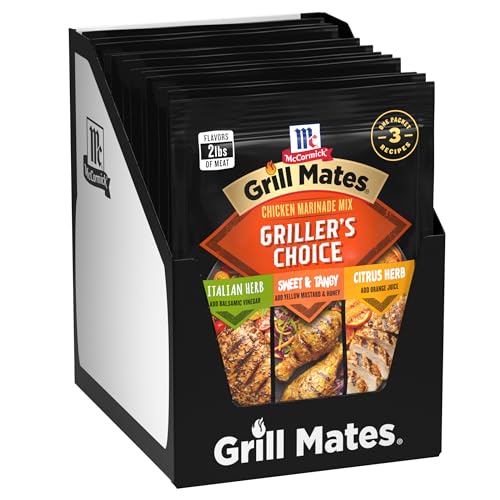
Chicken marinade packet from McCormick Grill Mates lets you choose the flavor you want

3-Pack Sampler of Signature Marinades – Includes three 16 oz bottles: Spiedie Original Marinade, Lemon Garlicious Marinade, and Chicken BBQ Marinade. A perfect variety pack to explore the bold, tangy flavors that put Salamida on the map.

Contains (3) 12 oz marinades
Preheating Your George Foreman Grill
Before you place your prepared chicken on the grill, proper preheating is essential to guarantee even cooking and exceptional grill marks. Start by inserting the temperature control probe into its receptacle and plugging the power cord into a standard 120V outlet. Turn the temperature dial to your desired heat setting—typically level 3 or 4 for chicken breast—then close the lid.
Allow the grill to preheat for 5-10 minutes until the indicator light turns off, signaling you’ve reached working temperature. This duration verifies proper temperature calibration and superior heat distribution across the cooking surface. The light indicator for preheating is essential to monitor, as waiting for it to turn off ensures your grill has reached the correct temperature. Most George Foreman grills require approximately 10 minutes to reach optimal preheating temperature for best results. George Foreman models are recognized for their versatile indoor/outdoor use with authentic sear marks capability. Like tabletop grills designed for portability, George Foreman grills benefit from even heat retention to ensure consistent cooking results. George Foreman grills offer precise temperature control similar to electric heating elements found in modern outdoor grills. These compact electric models are ideal for apartment and balcony dwellers seeking convenient cooking solutions without taking up extensive space. Don’t skip preheating; insufficient heat causes chicken to stick and prevents proper browning. Verify the thermostat light glows and the non-stick surface is clean before cooking begins.
Cooking Times for Different Chicken Breast Sizes
Once your George Foreman Grill reaches ideal temperature, cooking time becomes the primary variable determining whether your chicken emerges perfectly cooked or overdone. Ideal chicken thickness greatly impacts duration. Thin breasts (½” thick, 6-8oz) require 4-6 minutes total with the lid closed. Standard 1″ breasts need approximately 8 minutes—4 minutes per side. Thicker cuts beyond 6-8oz demand additional time, often exceeding 6 minutes.
When marinating chicken breasts, pat them dry afterward to prevent extended cooking times. Marinated breasts typically need 6 minutes per side. Properly preparing your chicken by patting the meat dry helps ensure even cooking and optimal texture. For optimal results, use a meat thermometer to verify the internal temperature reaches 165°F rather than relying solely on elapsed time, as thickness variations affect actual cooking duration considerably. Flipping the chicken several times during the cooking process promotes even heat distribution across all surfaces. Preheating the grill for about 5 minutes before adding chicken ensures even and thorough cooking throughout. Using a meat thermometer to check doneness takes the guesswork out of determining when your chicken has reached the safe internal temperature of 165°F. Resting the chicken for a few minutes after cooking allows the juices to redistribute throughout the meat, yielding more flavorful results.

0.3 Sec Readings: Unfold the 4.3 inch 304 stainless probe and the screen wakes; the thermocouple tip reads a steak, chicken or burger in 0.3 seconds, so the grill lid is up...
Checking for Doneness With a Meat Thermometer
The most reliable method for determining when your chicken breast has finished cooking involves inserting an instant-read thermometer into the thickest section of meat, carefully avoiding any bones that’d compromise your reading. Proper probe placement guarantees accurate temperature readings essential for food safety.
Push the thermometer through the thickest meat and pull slowly to identify the lowest temperature zone. You’ll target 165°F (74°C) as your safe internal temperature, which eliminates harmful bacteria like salmonella. Remember that color of cooked chicken does not necessarily reflect whether the meat has reached a safe temperature. An inexpensive meat thermometer is a must-have kitchen tool for consistently achieving perfectly cooked results. For the most reliable readings, consider using a one-second instant-read thermometer like those designed for professional BBQ applications. Models like the ThermoWorks Thermapen ONE are praised for their fastest and most accurate performance in speed and consistency tests.
Monitor temperature monitoring trends by checking multiple spots in larger breasts. For superior accuracy in your readings, models with ±0.5°F accuracy provide precise temperature detection that eliminates guesswork. Consider pulling your chicken at 158°F-160°F to account for carryover cooking during the 5-minute rest period, which raises temperature 5°F-7°F naturally. For George Foreman grills specifically, maintain a medium or medium-high heat setting to cook chicken properly without drying it out. This technique prevents overcooking while maintaining food safety standards that protect against harmful bacteria and ensure your meal is safe to consume. This technique prevents overcooking while maintaining food safety standards.

Fast & Accurate: Get precise readings in just 1 second with ±0.9°F accuracy. NSF Certified for trusted food safety, this digital food thermometer features a 4.3 inches food-grade stainless steel meat probe, perfect for grilling, frying, baking, making candy and more

【8X Faster + 4X More Precise】: Upgraded with an industrial-leading professional thermocouple sensor, Themomonster meat thermometer digital with NIST certified ±0.5℉ precision provides you the accurate temperature of your food in just 0.5 Seconds.

【Fast & Accurate】Our meat thermometer digital delivers accurate readings within ±1°F in just 1–2 seconds, with a wide temperature range of -58°F to 572°F (-50°C to 300°C). No more waiting over the heat - know your food's exact temperature instantly.
Resting and Serving Your Grilled Chicken
As your chicken finishes its carryover cooking phase, you’ll want to transfer it to a plate or cutting board for a 5-10 minute rest period. This resting duration allows the muscle fibers to relax and redistribute internal juices evenly throughout the meat, substantially enhancing juiciness and preventing dryness.
During this critical window, the carryover cooking effects continue working to optimize tenderness and texture. Avoid cutting into your chicken immediately, as premature slicing releases retained moisture and compromises palatability. To further preserve moisture, ensure your chicken has reached an internal temperature of 165°F before serving to guarantee food safety without overcooking. If you have leftover grilled chicken, safely freeze it on the day of cooking to maintain both safety and quality for future meals. Similar to sealing salmon in foil packets, allowing adequate resting time retains moisture and prevents the meat from drying out. Grilled chicken’s high protein content supports your metabolism and helps maintain energy production throughout the day. For optimal results, allow the chicken to rest for several minutes before serving, as this resting period significantly enhances juiciness and flavor retention.
Once rested, slice your chicken and serve it alongside complementary sides like quinoa, couscous, or grilled asparagus. You can also incorporate the sliced chicken into salads for convenient meal preparation. For additional flavor depth, consider brushing your chicken with BBQ sauce near the end of grilling to caramelize the sugars and add a delicious glaze. This methodical approach guarantees you’ll consistently achieve tender, succulent results from your George Foreman grill.