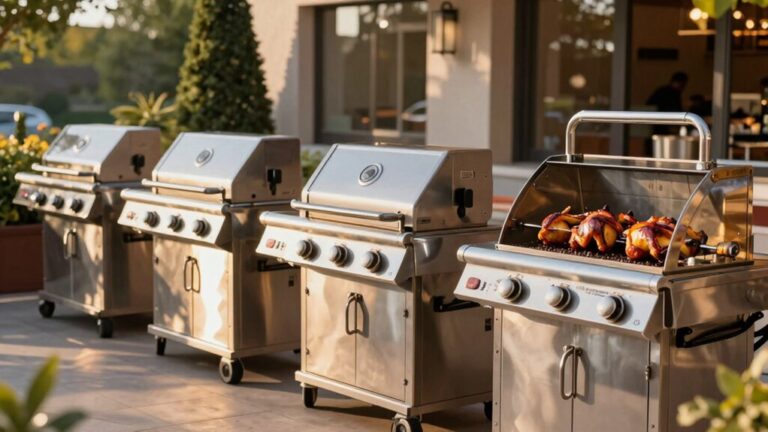

You’re getting Weber grills from two primary U.S. facilities: Palatine specializes in premium Genesis II and Summit models, while Huntley produces 15,000 charcoal kettle variants daily. Internationally, Weber’s €55 million Zabrze, Poland facility has operated since October 2021, serving European, Middle Eastern, and African markets. Both hubs utilize sophisticated procurement systems managing supplier relationships, quality standards, and logistical coordination. Component sourcing prioritizes cost efficiency and geographic proximity, reflecting evolving global production strategies that determine your grill’s origin.
Domestic Production Models and Illinois Manufacturing
Weber’s domestic manufacturing operations center on two Illinois facilities that handle distinct production functions. The Palatine facility specializes in premium Genesis II and Summit line assembly, while the Huntley plant focuses on charcoal kettle grills and produces approximately 15,000 different Weber products daily.
You’ll find that both locations utilize a robust regional supply chain, sourcing steel frames and primary structural components from Midwest-based suppliers. The company’s continuous improvement initiatives emphasize workmanship protocols that prioritize durability and precision throughout fabrication and assembly operations. This commitment to quality and durability reflects Weber’s dedication to building grills that last for generations of outdoor cooking enjoyment.
Quality control testing includes environmental chamber testing with salt water spray and temperature cycling to ascertain durability standards. Complete assembly processes occur at these Illinois facilities for all domestically assembled models, incorporating both U.S.-manufactured steel components and selectively sourced overseas hardware elements. However, Weber settled a 2012 class action lawsuit regarding Made in the USA claims because some grill components are imported from global suppliers. Unlike competitors such as Traeger, which shifted to manufacturing wood pellet grills in China and Vietnam after its 2006 sale, Weber maintains significant domestic production capacity in its Illinois facilities. The Genesis line features even heat distribution and continues to earn recognition as a top performer in the premium gas grill category. Weber emphasizes corrosion resistance in their stainless steel models through careful material selection and protective design features.
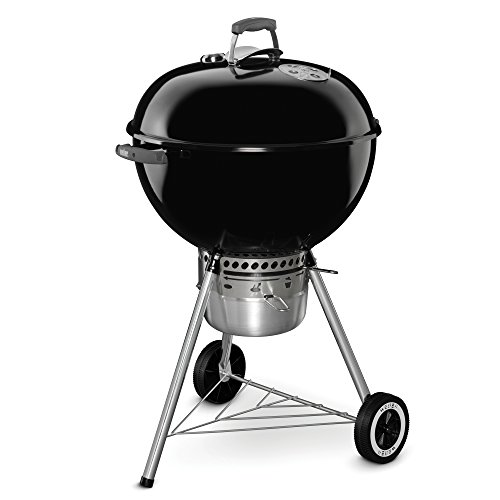
This premium Weber kettle grill has space to hold up to 13 burgers made with a Weber burger press; The durable-plated steel cooking grate, crafted from premium steel, offers a resilient surface that stands up to the demands of frequent grilling
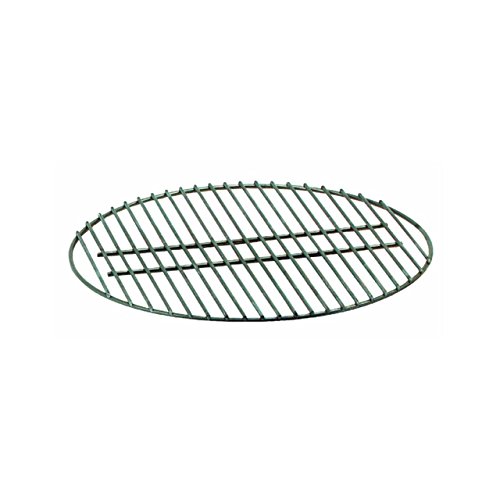
The lower grate in a charcoal grill creates a space between the vents and the coals allowing air to get to the coals
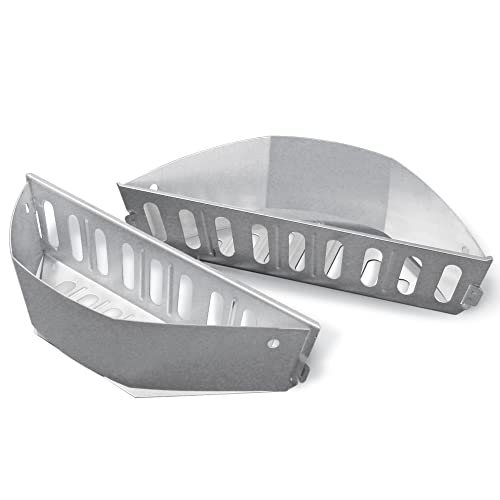
Fit up to 10 regular-sized briquettes in each charcoal holder
International Manufacturing Operations
How’s Weber expanding its global footprint? You’ll find the company’s first international manufacturing hub in Zabrze, Poland, operational since October 2021. This 50,000-square-meter facility represents a strategic production capacity expansion aligned with Weber’s “Make-Where-We-Sell” strategy.
The Poland operation supports local supply chain optimization by reducing delivery times to European retailers and minimizing transportation emissions. You’re looking at a €55 million investment employing over 250 people, producing charcoal and gas grills for European, Middle Eastern, and African markets. The facility was officially opened with a ribbon-cutting ceremony on October 8, 2021, celebrating Weber’s important milestone in global expansion.
The facility incorporates BREEAM sustainability certification and houses the Weber Grill Academy Experience Center, where visitors can participate in culinary classes and interactive chef’s tables. Built in approximately one year despite pandemic constraints, this manufacturing hub enhances operational efficiencies while meeting fast-growing European demand. The Poland facility produces components compatible with various outdoor cooking setups, including stainless steel grill islands that can be integrated into covered outdoor kitchen configurations. Weber’s manufacturing expertise in 304 stainless steel components ensures weather-resistant durability comparable to premium outdoor kitchen brands. Many of these grills pair well with grilling stones that provide non-stick surfaces and evenly distribute heat for superior flavor. Like premium brands, Weber’s built-in models feature insulated jackets that provide essential safety protection when integrated into outdoor kitchen islands. Weber’s focus on corrosion resistance ensures their grills maintain structural integrity in harsh outdoor environments, matching the durability standards set by high-end outdoor kitchen manufacturers.
Component Sourcing and Global Integration
Beyond the strategic placement of manufacturing facilities, you’re encountering a complex web of component sourcing that enables Weber’s global production network. While publicly available documentation doesn’t detail Weber’s specific supplier selection criteria or global procurement strategies, the company’s distributed manufacturing model necessarily requires coordinated sourcing across multiple regions.
You’d find that efficient component integration depends on supplier relationships, quality standards, and logistical coordination between facilities. Weber’s ability to manufacture grills across different continents suggests sophisticated procurement systems managing materials flow, parts compatibility, and regulatory compliance. The company maintains an extensive inventory of replacement parts to ensure seamless availability of components across its manufacturing and distribution network. Recent manufacturing shifts have resulted in more Weber grills being manufactured overseas, reflecting evolving production strategies and global market demands.
The company’s supplier selection likely prioritizes cost efficiency, reliability, and geographic proximity to production sites. Like other outdoor cooking manufacturers, Weber must balance American innovation and global manufacturing to deliver reliable products while maintaining competitive pricing. Proper maintenance of these globally-sourced grills includes regular cleaning of cooking grates and removal of carbonized grease to ensure optimal performance. Protecting finished grills from weather elements during storage and transportation requires durable grill covers that resist UV damage and environmental conditions. However, extensive data on Weber’s actual sourcing partnerships and procurement operations remains proprietary information not disclosed in public records.

𝐓𝐡𝐞 𝐁𝐞𝐬𝐭 𝐂𝐡𝐨𝐢𝐜𝐞 — 𝐘𝐢𝐥𝐚𝐝𝐨𝐫 𝟐𝟐-𝟏/𝟐-𝐈𝐧𝐜𝐡 𝐎𝐧𝐞-𝐓𝐨𝐮𝐜𝐡 𝐂𝐥𝐞𝐚𝐧𝐢𝐧𝐠 𝐒𝐲𝐬𝐭𝐞𝐦 𝐑𝐞𝐩𝐥𝐚𝐜𝐞𝐦𝐞𝐧𝐭
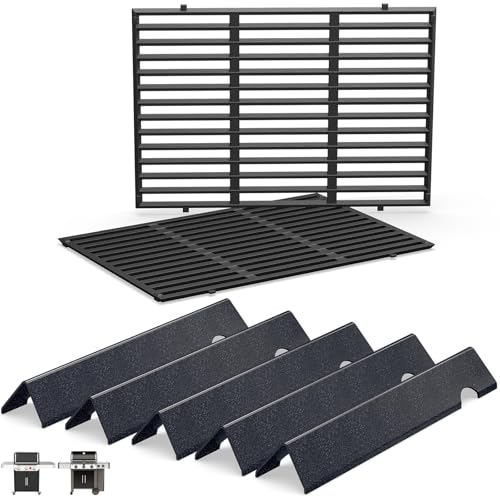
🔥【FITS WEBER GENESIS II 300 SERIES GRILLS】Fits Weber Genesis ii E-310, Genesis ii S-310, Genesis ii SE-310, Genesis ii E-315, Genesis ii E-325, Genesis ii E-330, Genesis ii SE-330, Genesis ii CE-330, Genesis ii S-335, Genesis ii SE-335, Genesis ii E-335, Genesis ii S-345(2017 and newer). Replace for weber part # 66095 #66802 grates, #66032, 66795 Flavorizer Bars . Also fits KitchenAid models 720-0954 720-0954A

EASY LIFT: Built in handles allow you to easily add more fuel while cooking.
Labeling Standards and Consumer Transparency
Every grill that leaves a Weber factory carries labeling that communicates manufacturing origin, safety compliance, and product specifications to consumers. You’ll find detailed information about U.S. and globally sourced components, highlighting Weber’s manufacturing transparency commitment. The labels incorporate quality assurance protocols that document rigorous testing—every lid examination, igniter test, and burner verification performed before shipment. Certifications and regulations guide all labeling requirements, including Proposition 65 warnings on charcoal grills for potential exposure to carbon black and carbon monoxide. Weber applies these warnings proactively nationwide, ensuring you access complete safety information regardless of purchase location. To maintain label durability and readability throughout the grill’s lifecycle, Weber utilizes modulated vacuum systems that ensure precise label application without shifting or misalignment during the manufacturing process. Advanced thermal inkjet printing technology enables Weber to mark batch numbers and expiration dates directly on labels for consumer convenience. Dome labels feature protective polyurethane coatings, while heat transfer logos maintain durability under extreme temperatures. This extensive labeling system reflects Weber’s dedication to transparency and your informed purchasing decisions.

Universal compatibility for various Grill: This is designed as a handy set of replacement decal stickers for your Gas Grill labels.
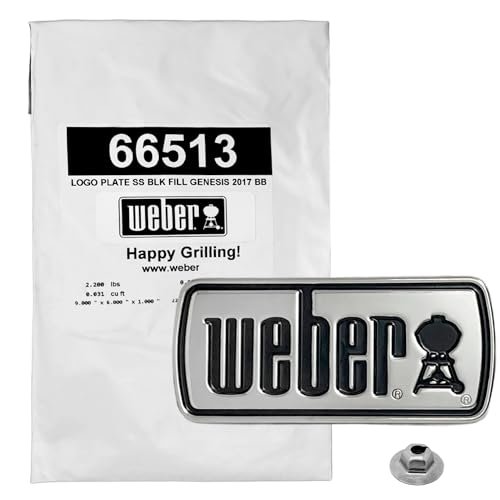

Effortlessly replace worn-out labels for Weber Genesis 2 and Spirit 2 style burners
Historical Context and Company Evolution
Why did Weber’s kettle grill become an iconic American staple? You’ll find the answer in the company’s evolution from sheet metal manufacturing to focused grill production. George Stephen Sr. invented the kettle grill in 1951, repurposing buoy components from Weber Brothers Metal Works. By 1958, organizational leadership changes positioned Stephen as full owner, establishing Weber-Stephen Products Co. dedicated exclusively to barbecue manufacturing. The company achieved 15,000 units annually by 1959 through strategic product expansion via nationwide demonstrations and television marketing. While late 1970s-1980s diversification attempts—including lanterns and mailboxes—yielded poor financial results, management refocused entirely on grill innovation. Stephen recognized the potential of gas grills in 1972 but maintained focus on charcoal production during that period. This strategic realignment, coupled with gas grill development beginning in the early 1970s and the Genesis line’s 1985 launch, solidified Weber’s market dominance. The company’s focus on innovation continued through major acquisitions, including Ducane Products Co. in 2004, which expanded Weber’s product portfolio and market reach. Weber later entered the pellet grill market, developing models with PID controllers and sear-focused features to compete in the growing category. The Weber Genesis E-315 exemplifies the company’s commitment to quality engineering with its even heat distribution and 10-year warranty. Weber also expanded into portable outdoor cooking solutions, with models like the Weber Traveler delivering power and transportability for camping and backyard use. The Weber Smoke pellet grill demonstrated the company’s ability to deliver consistent performance in the competitive pellet category with a $1,000 price point. Modern pellet smokers from competitors feature innovations like WiFi connectivity for remote temperature monitoring and smoke boxes for authentic barbecue flavor.