You’re operating a sophisticated cooking system when you fire up a pellet grill—an automated device that uses compressed hardwood pellets, electronic temperature controls, and convective heat circulation to deliver precise, consistent results. An ignition rod initiates combustion while an auger automatically feeds pellets and maintains temperatures within 15°F variance. Advanced grease management systems prevent flare-ups, and digital controllers enable remote monitoring. You’ll access smoking, roasting, baking, grilling, and searing capabilities with this versatile equipment, though understanding each component’s role reveals the true depth of what’s possible.
Understanding Pellet Grill Technology
At their core, pellet grills operate through a sophisticated interplay of fuel combustion, automated temperature control, and convective heat distribution. You’ll appreciate how the electronic controller maintains precise temperatures by monitoring your grill’s interior through a thermostat, then adjusting the auger’s pellet feed rate accordingly. This automated system cycles on and off, ensuring consistent heat without your intervention.
The sustainability considerations are significant—you’re burning compressed hardwood derived from sawmill waste, creating minimal environmental impact. Modern grills feature advanced grease management systems that channel rendered fat away from the firepot, preventing flare-ups and simplifying cleanup. A strategically positioned fan circulates air for effective combustion while distributing smoke evenly across your cooking surface. The ignition rod starts the fire to initiate the pellet combustion process. Different wood pellet flavors like hickory, mesquite, apple, and cherry allow you to customize the wood-fired taste of your food. The versatility of pellet grills enables you to smoke, roast, bake, grill, and sear with ease, combining modern convenience with traditional wood-fired cooking methods. Digital controls, including WiFi-enabled models, let you monitor and adjust temperatures remotely, delivering restaurant-quality results effortlessly. Premium models offer digital temperature control that maintains accuracy within +/-15°F, ensuring consistent cooking performance across extended sessions. High-end units can achieve impressive temperature ranges from low-and-slow smoking at 160°F all the way up to 600°F for searing steaks. Regular ash cleaning is essential to maintain optimal airflow and combustion efficiency throughout the grill’s operation. Before your first cook, properly seasoning the grill by running it through a complete heat cycle helps cure protective coatings and ensures optimal performance.
The Mechanics Behind the Heat
Understanding how your pellet grill transforms compressed wood into consistent, controllable heat requires examining the system’s core components and their integrated functions. Your grill ignites pellets through an electric rod, then feeds them automatically via an auger while combustion fans manage airflow dynamics to guarantee clean, even burning. Induction fans circulate heat throughout the chamber, maintaining precise temperature control within 15°F variance. Heat plates and the FlameZone pan’s conic vents distribute infrared energy across your cooking surface rather than concentrating it centrally. This design reduces pellet consumption while maximizing smoke output at lower temperatures. The wood pellets are made from 100% all-natural hardwood that has been dried and ground into sawdust before being pressurized at extreme heat to create these compact pellets. Simultaneously, ash management systems channel grease away from combustion zones through drip trays and grease traps, preventing dangerous flare-ups while maintaining consistent cooking temperatures throughout your session. The 88 conic vents stamped across the FlameZone surface allow heat contact with food while preventing flame escape and reducing flare-ups for superior cooking performance. During initial startup, the digital temperature controls regulate the auger speed to deliver pellets to the burn pot, initiating the automatic ignition sequence that produces heavy white smoke before reaching your target temperature. Premium brands like Lumberjack and Bear Mountain deliver bold smoky flavors through 100% natural hardwoods without fillers or additives, ensuring clean-burning performance ideal for ribs, brisket, and pork. Different hardwood varieties like hickory, oak, mesquite, and fruit woods such as apple or cherry each impart distinctive flavor profiles to your food, from hickory’s savory bacon-like smoke to the sweeter notes of fruit woods. Many manufacturers offer pellet blends that combine multiple wood types to create unique flavor combinations suited to specific meats and cooking styles.
Choosing the Right Wood Pellets
While your pellet grill’s mechanics deliver precise temperature control, the wood pellets you select fundamentally determine your food’s final flavor profile and smoking characteristics. You’ll find three primary composition types: pure hardwood pellets offering singular flavors, blended pellets combining oak bases with flavor woods for consistent BTU output, and heartwood-only options that burn cleaner. Match mild apple and cherry to poultry and seafood, while reserving hickory and mesquite for beef. Select universal blends like pecan or oak for stocking essentials. Prioritize brands like CookinPellets and Bear Mountain that use no fillers. Brands like Traeger use 100% virgin hardwood in their pellet composition to ensure consistent quality. Top performers like Lumber Jack Pellets deliver 100% pure hardwood without oak fillers, producing minimal ash and strong flavors at an affordable price point. For those new to pellet smoking, variety packs with 1-pound bags allow you to test different wood flavors before committing to larger quantities. Hickory pellets provide a rich, smoky flavor that pairs exceptionally well with pork, chicken, and beef, making them a southern barbecue favorite. B&B Post Oak Pellets are praised for their pure post oak wood with no additives, delivering flavorful smoke ideal for beef and pork in any pellet grill. Consider mixing wood pellets to balance intensity when strong flavors like mesquite or walnut might overpower lighter proteins. Never use pellets made from softwoods like pine, as their high resin content produces acrid smoke and can damage your equipment. Quality pellets directly impact your smoker’s performance and prevent excessive ash production that complicates pellet grill igniter replacement and pellet smoker maintenance procedures.

SIGNATURE BLEND WOOD FIRED FLAVOR: The flavors of hickory, maple, and cherry hardwoods combine for in our Traeger Signature Blend Hardwood Pellets for flavor that can take on just about anything you cook; From classic BBQ meats, to fish and veggies, this versatile blend gives you full-bodied flavor you'll go back to time and time again

KINGSFORD CRAFTSMOKE PREMIUM WOOD PELLETS: Introducing Craftsmoke, the premium line of natural hardwood pellets, crafted in small batches for the chef in all of us; pack may vary

100% all-natural premium hardwood food grade pellets
Essential Components Explained
How does a pellet grill transform raw fuel into consistent, flavorful smoke? Understanding your grill’s core components is essential for ideal performance.
The hopper stores pellets—typically 20-40 pounds—with a protective lid preventing moisture intrusion. Below sits the firepot, where an electric hot rod igniter heats to ignition temperature within minutes, combusting pellets for steady flames. This design guarantees efficient fuel consumption and heat retention. The igniter typically operates at 200 watts to achieve rapid combustion and reliable startup performance.
Your cooking grates, constructed from expanded metal or stainless steel with porcelain coating on select models, distribute heat evenly across the cooking surface. The chimney vents smoke while the grease shield prevents flare-ups. An induction fan circulates heat and smoke throughout the cooking chamber for even temperature distribution. Modern pellet grills often feature WiFi-enabled controllers that allow precise temperature and smoke control for optimal cooking results.
Understanding these interconnected parts helps you recognize maintenance requirements—cleaning firepots, inspecting igniters, replacing worn grates. Regular vacuuming of sawdust from the hopper and firepot prevents buildup that can affect performance and ignition reliability. You’ll also appreciate critical safety considerations: proper ventilation, regular component inspection, and correct pellet quality selection. Many grills now include a storage cabinet beneath the main chamber that provides convenient space for pellet bags, tools, and accessories. For backyard enthusiasts seeking maximum cooking capacity, vertical pellet smokers offer expanded rack space and superior insulation for consistent temperature control during long cooks. High-end models like the Yoder Smokers YS640S deliver exceptional performance with premium build quality and advanced features that justify their price points. Mastering these elements maximizes your grill’s lifespan and cooking results.

Fits Traeger Pellet Grills; Please Noted: This fire burn pot fits Traeger and most Pit-boss pellet grills

🔥【 Perfect Compatibility】This upgraded fire burn pot for pellet grills is a high-quality Traeger replacement part, fitting Traeger and most Pit Boss pellet grills (except PTG). Compatible with Traeger Texas Elite Series, Pro 22/575, Pro 34/780, 070/075, Lil Tex Elite; Pit Boss Austin XL, 820/850/700/540/500; as well as Camp Chef and Z Grills 550A/7002B/7002E/10002B/10002E. As a direct replacement fire pot, it restores your pellet grill to peak performance all season long

【COMPATIBILITY】: This fire burn pot compatible with Traeger Grills (EXCEPT PTG) and most Pit-boss pellet grills (not all).NOTE: Not Fit For Traeger D2 Direct Drive Pellet Grills Smoker Pro 575 & 780, Ironwood 650 & 885, Silverton 620 & 810, Timberline 850 &1300 (Gen 2 only), Century 885. Pit Boss Pro 1150/1160 Pellet Grill.
Temperature Control and Precision Cooking
Because maintaining exact cooking temperatures separates amateur results from competition-quality barbecue, pellet grills rely on sophisticated PID (Proportional-Integral-Derivative) controllers to regulate heat with remarkable precision. Your RTD temperature probe continuously monitors internal conditions, feeding real-time data to the controller, which then adjusts auger feed rates and fan speeds accordingly.
This system maintains temperatures within a tight 5-10°F range, eliminating the dramatic temperature swings you’d experience with conventional controllers. You’ll achieve targeted temperature profiles for smoking jerky at 100°F or searing steaks at higher heat without manual intervention. The controller uses an algorithm to adapt to variances and external influences, ensuring consistent heat output regardless of outdoor conditions. Modern controllers update with FREE lifetime firmware updates to continuously improve performance and add new cooking capabilities.
Advanced models feature integrated wifi controls, enabling you to monitor and adjust settings remotely via smartphone. When evaluating wifi-enabled pellet grills, check recent user reviews for app performance and wireless connectivity reliability before purchasing. The controller’s algorithm anticipates environmental factors like wind and ambient temperature, automatically compensating to stabilize your cook. Hands-on tests confirm that precise PID controllers deliver consistent heat regulation even during overnight cooks that can last 12 hours or more. Top performers like the Pit Boss 850 DX feature stable PID controllers paired with large hoppers that make extended overnight cooking sessions reliable and worry-free. For maximum accuracy, pair your pellet grill with a quality grill thermometer to verify internal meat temperatures and ensure food safety throughout the cooking process. This precision delivers consistent, competition-quality results across all cooking applications. Maintaining this precision requires following regular cleaning schedules to prevent grease buildup that can interfere with temperature sensors and airflow patterns.

WIDE COMPATIBILITY: The control panel can fit a wide range grill models of Traeger , Pit Boss, Z grills and Asmoke. See picture for specific model.

Advanced PID Algorithm & Universal Fit: Equipped with a cutting-edge PID temperature control system, this WiFi controller ensures superior cooking stability. The Wifi pellet grill controller offers wide-ranging compatibility, supporting a comprehensive range of Pitboss and Traeger models for effortless installation and reliable performance. Pit boss Pellet Smoker grills: PB340, PB440D, PB440TG1, PB440TGR1, PB700D, PB700R1, PB700S, PB700S1, PB700T1, PB700FB, PB700FBM2, PB700SC, PB700R2, PB700S2, PB820D, PB820T1, PB820S, PB820FB, PB820FBC, PB820SC, PB1000S1, PB1000T1, PB1000SC1, PB1000R2, PB1000T2, PB1000R1

MASSIVE COMPATIBILITY: Direct upgrade replacement for Traeger Pro 20/22/34, Texas Elite 34, Lil Tex 22, Century, Silverton 2019, Pit Boss PB440/PB700/PB820/PB1000 series, Z-Grills 600/700/1000 series, and Asmoke AS300/350/500N/550 models. Fits standard vertical rectangular cutouts and is ideal for upgrading older pellet smokers with modern Wi-Fi control technology.
Versatility in Outdoor Cooking
Once you’ve mastered temperature precision on a pellet grill, you’ll reveal its true advantage: the ability to execute virtually every outdoor cooking technique on a single platform. You’ll leverage multi-zone functionality and direct/indirect cooking capabilities to simultaneously employ advanced cooking techniques—searing steaks at 700°F while smoking brisket at 225°F in separate chambers.
Your specialized cooking applications expand dramatically across diverse foods. You’ll roast vegetables, bake pizzas, braise proteins, and char-grill all with exceptional results. The dual-chamber design eliminates the need for multiple devices, streamlining your workflow and enabling rapid technique shifts. Pellet grills can handle a wide range of cooking techniques, making them superior to traditional single-purpose outdoor cooking equipment. Modern pellet grills incorporate Wi-Fi connectivity for remote monitoring and adjustment, enhancing both convenience and precision during complex cooking sessions. These grills function as wood pellet-fired convection ovens, distributing heat evenly through a heating baffle system that maintains consistent temperatures throughout the cooking chamber. Models like the Ninja Woodfire Grill deliver authentic smoky flavors through dedicated smoke boxes that utilize premium hardwoods while maintaining electric function convenience.
With 970–1200 square inches of cooking area, you’ll accommodate large gatherings while executing complex, multi-temperature preparations. When evaluating models, consider critical features like temperature control precision, hopper capacity, and insulation quality that determine long-term performance and reliability. Leading manufacturers have introduced hybrid models that combine pellet efficiency with traditional grilling capabilities for maximum flexibility. Electric grills offer environmental friendliness and apartment compatibility where open flames face restrictions. This versatility transforms your pellet grill into an extensive outdoor cooking solution, replacing traditional grills, smokers, and ovens entirely.
Convenience Features and Automation
While the versatility of dual-chamber cooking represents a significant leap forward, the real transformation in modern pellet grilling emerges through automated systems that fundamentally shift how you interact with your equipment. Advanced digital controllers monitor interior temperatures over 200 times per minute, automatically adjusting pellet feed rates to maintain ±15°F precision without manual intervention.
Smart home integration and remote monitoring capabilities enable you to control your grill via mobile app—igniting it, adjusting temperatures, and receiving meat probe alerts from anywhere. Multi-sensor monitoring tracks multiple items simultaneously throughout extended cooking sessions. The Automation model offers 784 square inches of cooking capacity, accommodating everything from full turkeys to complete family meals across its direct and indirect cooking surfaces. This automation eliminates the expertise traditionally required, enabling longer unattended cooks while maintaining consistent fires and precise heat delivery across temperatures ranging from 170-600°F. Modern pellet grills like the Camp Chef Woodwind 24 provide direct flame access alongside their standard temperature range, giving you additional versatility for high-heat searing. However, some models experience temperature drift of 20-25 degrees above the setpoint, which may require periodic recalibration to maintain optimal cooking results. For outdoor enthusiasts and travelers, compact pellet grills offer portability features like folding legs and AC/DC power options that make them ideal for RV trips and tailgating events. When selecting a portable unit, consider important factors like hopper size versus weight tradeoffs, as larger pellet capacity extends cooking time but reduces transportability for camping and tailgating scenarios. The Pit Boss 440 SERIES features heavy-duty steel construction with a 5-pound hopper that provides an effective balance for medium-length cooking sessions without excessive bulk. Accessories like smoke tubes can enhance the wood-fired flavor profile by supplementing the pellet grill’s natural smoke output during low-temperature cooking sessions.

COMPATIBILITY: Direct replacement for Pit Boss Lexington (PB500LXW1) / Classic PB700FBW2 / Austin XL PB1000XLW1 / Matte Black PB440FB1. NOTE: NOT fits ONYX EDITION and Tailgater series.

Wide Compatibility: This grill motherboards is perfect replacement of Camp Chef Gen 2 Retro Fit Non-WiFi Pellet Grill controller, compatible with PG24-82 and multiple models including Pursuit 20, SG24, XT24, SGG/SG30, SGX36, DLX24/36, SmokePro DLX 24, LUX 36, STX 24, XT 24, and Woodwind Classic 24 series. Not compatible with Woodwind WiFi or XXL Vertical models

Universal Compatibility: This Wi-Fi control board serves as a direct upgrade replacement for leading pellet grill brands. It is fully compatible with Traeger series (including BAC236, BAC365, BAC288, Select Pro, Pro 22/34, Texas Elite 34), provides optimized replacement for Pit Boss series (PB340-PB820, 1000 Traditions, Rancher Series, Tabletop series), and delivers perfect replacement compatibility for Asmoke grill models (AS300, AS350, AS500/550 series). Please refer to the compatibility guide in the product images.
Pellet Grills Versus Other Cooking Methods
Understanding how pellet grills stack up against traditional cooking methods reveals their distinct advantages and limitations. You’ll find that pellet grills outperform gas and charcoal models in ease of maintenance, producing minimal ash residue while maintaining precise digital temperature control. Their fuel efficiency comparison demonstrates superiority for extended low-temperature smoking sessions, with automatic auger-fed pellets consuming less fuel than gas’s continuous propane draw. You won’t experience the flare-ups inherent to charcoal grilling, nor will you manage multiple temperature zones manually. However, you’ll sacrifice the rapid heat-up speed gas grills provide and accept electricity dependence. Pellet grills can provide 6-20 hours of cooking time per 20 lbs of pellets, significantly extending your grilling sessions without constant refueling. The auger system ensures minimal waste by automatically feeding pellets at precise rates throughout your cook. Pellet grills function as hybrid smokers, grills, and convection ovens, reaching 500°F for versatility that charcoal and gas models struggle matching. While gas grills require wood chip pouches or smoker boxes to generate smoke flavor, pellet grills integrate this capability directly through their fuel source. For high-heat applications like steak searing, some pellet grills incorporate dedicated sear attachments or cast-iron accessories to achieve restaurant-quality crusts that rival traditional charcoal grills. Modern pellet grills with integrated griddle surfaces expand cooking versatility by adding searing and breakfast-style cooking zones alongside traditional smoking capabilities. Top models like the Weber Searwood 600 offer direct flame searing and open-lid grilling capabilities that bridge the gap between traditional gas grills and pellet smokers. Consider your cooking-area size requirements when selecting between pellet and propane models, as this determines whether you can accommodate large gatherings or focus on everyday family meals. You’re fundamentally choosing consistency and automation over simplicity and raw power.

Replaces 3 speed smoker control, compatible with Traeger wood pellet grill models (except PTG)
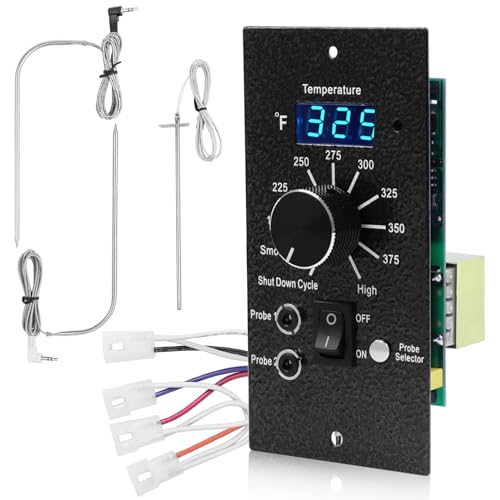
【COMPATIBILITY】: This Traeger Digital Controller kit replacement part compatible with most Traeger Wood Pellet Grills (except PTG), ideal replacement for Traeger Controller BAC365.

High mode can be used for highest heat possible. This product features auto start to self ignite your BBQ.
Why Pellet Grills Are Worth the Investment
Why should you invest in a pellet grill when you’re already cooking with conventional methods? Pellet grills deliver superior durability and cost effectiveness through their automated systems and efficient fuel consumption. You’ll experience minimal maintenance and upkeep compared to charcoal or gas alternatives—pellets burn cleanly with reduced ash accumulation, and the automated ignition eliminates manual adjustments. Their precision temperature control, ranging from 180°F to 500°F, guarantees consistent results across diverse cooking applications while reducing fuel waste. The Wi-Fi connectivity enables remote monitoring, further streamlining your cooking process. With convection heat circulating evenly, you’ll achieve faster cooking times and complete meals in single sessions. Pellet grills can be used for smoking, grilling, baking, and roasting, making them exceptionally versatile for any outdoor cooking need. The stainless-steel construction enhances both the longevity of your equipment and the safety of your outdoor cooking experience. The large cooking surface allows you to prepare multiple items simultaneously, from burgers and poultry to fish and breakfast foods, maximizing your outdoor cooking efficiency. Leading models like the Traeger Woodridge Pro feature large hoppers that extend cooking sessions without frequent refilling, adding to the convenience factor. To protect your investment from weather elements, consider a waterproof grill cover with UV resistance and a snug fit for long-term durability. While pellet grills excel at slow-smoking and versatile cooking, those seeking specialized high-heat searing might also consider flat top grills that can reach maximum temperatures exceeding 650°F for restaurant-style results. For pellet grill owners wanting even more outdoor cooking flexibility, models like the Grilla Primate offer hybrid grill-griddle functionality that combines multiple cooking methods in one unit. These features combine to reduce long-term operational costs and deliver measurable value through enhanced efficiency and decreased maintenance demands.